
Top 6 Infrastructure Modernization Consulting Companies
Summary: This article highlights 6 companies that help organizations modernize legacy infrastructure, improve operational efficiency, and build scalable cloud-ready environments through automation, DevOps, and system transformation.

Outdated infrastructure isn't just a technical liability — it's a competitive one, since modernized competitors ship features faster and handle more users on the same market.
- Ispirer takes a code-first approach, treating database migration and application conversion as the foundation of modernization rather than treating infrastructure as separate from the applications running on it — in one case converting millions of lines of PowerBuilder to Java for an airline software company without disrupting live operations.
- AWS Professional Services introduced automated migration frameworks that let Danske Bank move thousands of systems simultaneously, rather than migrating them one at a time through manual coordination.
- Endava's approach leads with deep dependency analysis before any transformation begins — mapping hidden risks across applications and infrastructure first let a global investment bank move forward in phases without large-scale disruption.
- THNKBIG modernized a manufacturing company's 200+ virtual machines using Kubernetes and automated deployment pipelines, cutting the manual maintenance overhead that was slowing releases and increasing error rates.
The Current Landscape
Our time can be described as a race of technologies. Like Formula 1 drivers, companies are constantly trying to move faster than their competitors and gain an advantage through better technology.
But infrastructure is where this race is actually won or lost. Legacy systems slow everything down: releases take longer, scaling becomes expensive, and engineering teams spend more time maintaining than building.
The reality is simple. If your infrastructure is outdated, your competitors who are already modernized will move faster than you. They will operate more efficiently: deliver features quicker and handle more users.
According to multiple industry reports, companies that delay modernization face rising operational costs and increasing technical debt, while those investing in modernization see measurable gains in productivity and speed.
Below, we look at companies that help solve problems mentioned above.
Ispirer
Ispirer is an international software company that provides customers with an effective way to improve IT infrastructure. Backed by more than 25 years of migration expertise, the company focuses on automating legacy transformations through database migrations, application conversion, and engineering services.
In the context of infrastructure modernization, Ispirer addresses one of the most critical constraints — the data layer. Instead of treating infrastructure as isolated from applications, Ispirer’s IT infrastructure modernization consultants rebuild systems at the code and database level, making modernization sustainable rather than superficial.
How Ispirer approaches infrastructure modernization
- Automated database migration as a foundation for modernization
- Application conversion and refactoring
- Code-first transformation approach
- Integration of DevOps and quality engineering practices
- Security built into the modernization process
- Cost optimization through architectural changes
Legacy databases are converted into modern, open-source platforms, removing licensing constraints and enabling scalable infrastructure.
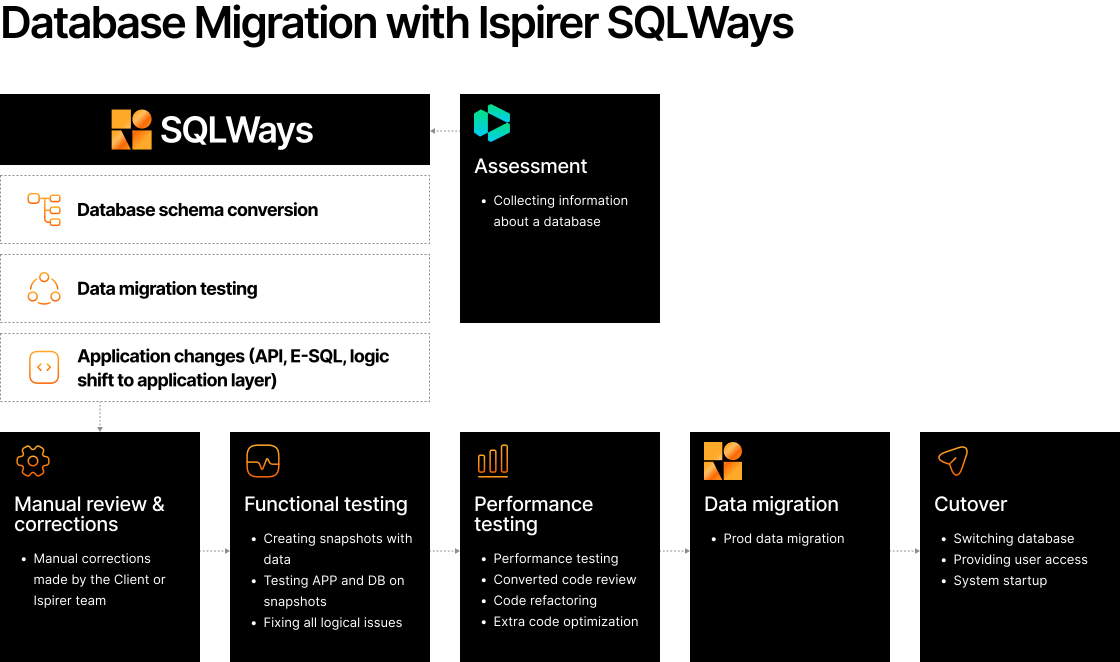
Learn more: Automated Infrastructure Modernization
Outdated codebases are transformed into modern languages by infrastructure modernization software, allowing systems to operate efficiently in new environments.
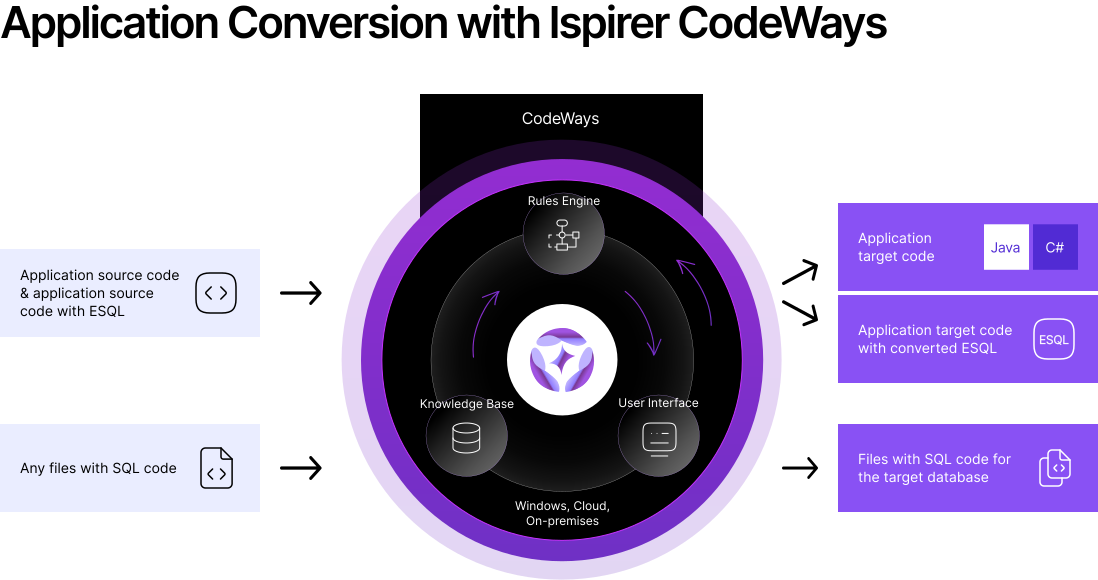
Learn more: IT Infrastructure Transformation Services
Infrastructure is modernized by addressing application logic and dependencies, eliminating hidden limitations that prevent scaling.
Learn more: Application Modernization
Automated testing and deployment pipelines ensure stability and reduce risk during transformation.
Vulnerabilities in legacy code are addressed during conversion, ensuring that modern infrastructure is secure by design.
Systems are redesigned to eliminate overprovisioning and reduce long-term operational costs.
How we modernized a legacy system
We worked with a software company operating in the airline industry whose system was built on PowerBuilder and contained millions of lines of code. Over time, the application became increasingly difficult to evolve due to its size and complexity, making large-scale changes risky and resource-intensive.
The project focused on converting PowerBuilder scripts to Java using the Ispirer Toolkit (infrastructure modernization tools), which was customized to maximize automation. During the migration, special attention was given to preserving business logic and ensuring correct interaction with the existing database.
The team also implemented custom infrastructure modernization solutions for migrating visual components and DataWindows into Java-based structures. This required adapting both the application architecture and UI elements to the target environment.
The migration was completed without disrupting critical functionality, allowing the system to continue operating while transitioning to a modern technology stack.
As a result, the client received a more maintainable system with improved performance and a solid foundation for further modernization.
AWS Professional Services
Amazon Web Services Professional Services helps organizations modernize infrastructure directly within AWS environments if compared with other IT consulting firms providing cloud infrastructure modernization services. The company combines consulting with platform-native tools to accelerate transformation.
It is particularly effective in large-scale migrations where speed and control are critical.
Cloud-driven modernization capabilities
- Structured cloud migration execution
- Cloud-native infrastructure redesign
- Automation of migration processes
- Security and compliance architecture
- Cost optimization through cloud resource management
- Enablement of data and AI workloads
Systems are moved in phases to ensure stability and minimize risk.
Applications are adapted to fully utilize cloud capabilities.
Automated tools reduce manual effort and speed up transformation.
Infrastructure is designed to meet regulatory and security requirements.
Resource usage is optimized to reduce unnecessary spending.
Infrastructure is prepared for advanced analytics and machine learning.
How AWS accelerated modernization for Danske Bank
AWS worked with Danske Bank, which needed to modernize a complex infrastructure with thousands of systems. Traditional migration approaches were too slow and required extensive manual coordination.
The bank needed a faster and more efficient way to transition to the cloud.
AWS introduced automated migration frameworks that allowed multiple systems to be moved simultaneously. Infrastructure was redesigned for cloud-native operation.
This significantly reduced migration time and improved scalability. It also maintained control and compliance throughout the process.
As a result, Danske Bank accelerated its transformation and improved infrastructure flexibility.
Plain Concepts
Plain Concepts focuses on infrastructure modernization, combining cloud architecture, DevOps practices, and application restructuring. The company works closely with engineering teams, ensuring that infrastructure changes are not isolated decisions but part of a broader system transformation.
Its approach is built around making infrastructure easier to manage, scale, and evolve, especially in environments where legacy systems limit flexibility.
Infrastructure modernization approach and services
- Infrastructure assessment and modernization planning
- Cloud and hybrid infrastructure implementation
- DevOps and CI/CD adoption
- Application decomposition and modernization
- Security and Zero Trust integration
- Compliance and security consulting for modern infrastructure
The company evaluates existing systems and defines a structured roadmap that prioritizes changes based on business impact and technical complexity.
Environments are designed to support both cloud and on-premise workloads, allowing gradual modernization without disruption.
Automated pipelines are introduced to reduce deployment time and improve consistency across environments.
Monolithic systems are restructured into modular architectures that are easier to scale and maintain.
Security is embedded directly into infrastructure design, reducing vulnerabilities in modern environments.
Systems are structured to meet regulatory requirements while maintaining flexibility.
How Plain Concepts modernized infrastructure for Heijmans
Plain Concepts worked with Heijmans, a company focused on urban infrastructure and smart city solutions. The challenge was to build a platform capable of processing real-time data from multiple sources while remaining scalable and reliable.
The existing infrastructure lacked flexibility and made it difficult to integrate new systems or scale operations. This limited the company’s ability to improve traffic flow and infrastructure efficiency.
Plain Concepts implemented a cloud-based architecture combining data ingestion, analytics, and monitoring. The platform was designed to scale dynamically and support real-time decision-making.
This improved system visibility and allowed operators to respond faster to changing conditions. It also enabled integration of additional data sources over time.
As a result, Heijmans improved infrastructure efficiency and created a scalable foundation for future smart city initiatives.
Endava
Endava takes a structured, data-driven approach to infrastructure modernization. The company focuses on understanding existing systems in detail before initiating transformation, which reduces risk and improves decision-making.
This approach is particularly effective in complex environments where legacy systems contain hidden dependencies.
Infrastructure modernization methodology
- Deep infrastructure and system analysis
- Data-driven transformation planning
- Cloud and platform transformation execution
- Automation and accelerators implementation
- DevOps and continuous delivery enablement
- Controlled and phased transformation delivery
Endava analyzes codebases, configurations, and dependencies to uncover hidden risks and inefficiencies.
Modernization strategies are built based on actual system insights rather than assumptions.
Systems are migrated to scalable environments while preserving functionality and stability.
Proprietary tools are used to speed up modernization and reduce manual errors.
Development and operations processes are modernized to improve release speed and reliability.
Changes are introduced incrementally to avoid disruption and maintain operational continuity.
How Endava helped a global bank modernize infrastructure
Endava worked with a major investment bank that struggled with technical debt and limited visibility into its infrastructure. Over time, systems had become so complex that even minor updates introduced significant risk.
The bank needed a clear understanding of its environment before starting modernization.
Endava conducted a detailed system analysis, mapping dependencies across applications and infrastructure. Based on this, it developed a phased transformation roadmap focused on the most critical areas.
This approach allowed the organization to move forward without large-scale disruptions. It also improved transparency and control over infrastructure changes.
As a result, the bank reduced modernization risk and gained a more predictable path toward infrastructure transformation.
Detecon
Detecon specializes in infrastructure transformation in industries with complex operational environments, such as telecommunications, logistics, and public sector systems. The company combines strategic consulting with hands-on implementation.
The goal of this infrastructure modernization provider is to simplify infrastructure while improving performance, scalability, and operational efficiency.
Infrastructure transformation capabilities
- Infrastructure modernization strategy development
- Cloud and hybrid architecture design
- Enterprise architecture restructuring
- Network modernization and automation
- Data center optimization
- Operational performance improvement
Detecon defines how IT infrastructure should evolve to support long-term business objectives.
Systems are redesigned to operate across flexible environments while maintaining stability.
Complex IT landscapes are reorganized into more manageable and efficient structures.
Network infrastructure is upgraded to improve performance and reduce manual intervention.
Infrastructure resources are optimized to reduce costs and improve efficiency.
Processes are streamlined to reduce workload and improve system reliability.
How Detecon modernized infrastructure for DB Cargo
Detecon worked with DB Cargo, where a legacy system was used to manage rail logistics operations. The system relied heavily on manual coordination and lacked integration between operational units.
This created inefficiencies and made it difficult to scale operations.
Detecon redesigned the infrastructure by introducing cloud-based components and automated workflows. Systems were integrated to allow better data flow across operations.
The modernization improved visibility and reduced reliance on manual processes. It also increased the speed and reliability of logistics operations.
As a result, DB Cargo achieved improved operational efficiency and a more scalable infrastructure.
THNKBIG
THNKBIG focuses on engineering-driven infrastructure modernization using cloud-native technologies. The company specializes in Kubernetes, automation, and DevOps practices that reduce operational overhead and improve system scalability.
Its work is centered on turning infrastructure into a flexible and manageable platform rather than a maintenance burden.
Engineering-driven modernization services
- Infrastructure assessment and prioritization
- Cloud-native transformation implementation
- Kubernetes-based infrastructure deployment
- DevOps and GitOps adoption
- Infrastructure as Code implementation
- Observability and security integration
THNKBIG identifies the most critical constraints that limit system performance and scalability.
Systems are redesigned to operate in distributed, scalable environments.
Container orchestration is introduced to improve flexibility and resource utilization.
Infrastructure management is automated through code-based workflows.
Manual configuration is replaced with consistent, repeatable processes.
Monitoring and security are embedded into infrastructure to improve reliability.
How THNKBIG transformed manufacturing infrastructure
THNKBIG worked with a manufacturing company managing more than 200 virtual machines across aging infrastructure. The environment required constant maintenance, and deployment processes were slow and error-prone.
The company needed to reduce operational overhead and improve scalability.
THNKBIG implemented a cloud-native architecture using Kubernetes, along with automated deployment pipelines and improved monitoring systems. Workloads were restructured and distributed across a more flexible environment.
This reduced manual work and improved system reliability. It also enabled faster deployment of updates and new features.
As a result, the company achieved higher efficiency, faster release cycles, and a modern infrastructure ready for growth.
Final thoughts
Whether to take part in this technological race or not is entirely your decision. But in reality, customer expectations and the need for higher productivity are already setting the pace.
Companies that invest in modern infrastructure are better positioned to deliver faster, operate more efficiently, and provide a stronger customer experience. Those that don’t often find themselves reacting instead of leading and missing the benefits of infrastructure modernization.
That’s why infrastructure modernization is rarely something companies do alone. Working with a reliable partner, one of the vendors for a quick application infrastructure modernization, makes the process more predictable and helps avoid costly mistakes along the way.
Do you have a migration project ahead?
Talk to expert. Save your time


