


1000+ companies including Fortune 500 and Global 2000 use Ispirer solutions. Join the champions.


Why companies migrate from Oracle to Microsoft SQL Server
The key business and technical drivers behind Oracle-to-SQL Server migration.
-
Prohibitive licensing costs
![Costs icon]()
Oracle licensing, support contracts, and audit risks drive up costs. SQL Server offers simpler licensing and a lower total cost of ownership.
-
End-of-support pressure
![Support icon]()
Unsupported Oracle versions risk security gaps and compliance issues. SQL Server provides ongoing support.
-
Cloud migration strategy
![Cloud icon]()
SQL Server integrates with Azure for cloud deployments, scaling, and managed database services. Oracle can complicate this transition.
-
Integration with the Microsoft ecosystem
![Integration icon]()
SQL Server connects with Azure, Power BI, Fabric, .NET, and Active Directory. Replacing Oracle reduces integration points and simplifies IT.
-
Talent and skills availability
![Skills icon]()
T-SQL skills are widely available, while PL/SQL expertise is more specialized. Migration reduces reliance on scarce Oracle skills.
-
Performance and scalability demands
![Performance icon]()
Microsoft SQL Server handles demanding workloads with in-memory OLTP, columnstore indexes, and Query Store.


Migration opportunities with Ispirer
Ispirer Ecosystem automates your migration routine to enable quick and smart transformation of any database. Double the migration speed with our comprehensive solutions.
With Ispirer Toolkit only
Ispirer Toolkit + Service
Ispirer Ecosystem for automated migration
Among the available Oracle to SQL Server migration tools, Ispirer Toolkit stands apart by targeting the full automation of conversion – not just schema transfer, but business logic, stored procedures, and data type mapping included. Where generic scripts and one-size-fits-all converters fall short, Ispirer's proprietary engine goes further, handling the Oracle-specific constructs, dependencies, and data type nuances that cause most migration projects to stall.
AI-powered SQLWays

Intelligent code conversion
The toolkit's intelligent algorithm doesn't just translate syntax. It analyzes object relationships, resolves inter-dependencies, maps Oracle data types to their SQL Server equivalents, and generates functional T-SQL code for constructs that have no direct counterpart in the target platform. The result is a higher automation rate from the start, fewer manual corrections after conversion, and a faster path to a production-ready SQL Server database.
Continuous improvement
The toolkit is compiled daily and continuously expanded with new conversion rules – meaning projects started today benefit from improvements built on thousands of real-world migration scenarios. For teams looking to migrate Oracle to Microsoft SQL Server with minimal manual effort, Ispirer Toolkit is purpose-built as an Oracle migration tool that grows with every project it processes.
Ispirer Systems is an ISO/IEC 27001 certified organization. We adhere to the highest international standards of information security.
Our modernization and migration approach
We select the right conversion approach based on business specifics, project scope, complexity, and risk profile.
-
Rule-Based
Deterministic conversion
Engine
SQLWays, CodeWays
Automation & coverage
~70–80% automated coverage out of the box, with the option to reach up to 90% through manual refinement, refactoring, validation, and QA
What you get
Predictable scope and timeline, stable and repeatable output
Best for
Well-defined, structured migrations
-
Recommended
Hybrid
Rules + AI-assisted refinement
Engine
SQLWays, CodeWays + AI
Automation & coverage
~70–80% automated coverage, up to 90% with AI, reducing manual conversion, validation, and testing
What you get
Predictability of the rule-based engine + speed of AI, backed by the Ispirer expert framework
Best for
Complex or partially undocumented systems
-
AI-Driven
AI-led analysis and delivery
Engine
AI engine
Automation & coverage
AI-led code and business logic extraction by Ispirer Migration Experts
What you get
AI-assisted refactoring, code generation and documentation, human-led QA, insights into undocumented logic and target design
Best for
Iterative modernization and innovation-driven transformation
The approach is defined during the Discovery Phase, based on business specifics, source system complexity, target state, timeline, and expected business value.
Oracle to SQL Server migration steps
A proven end-to-end approach that turns complex Oracle-to-SQL Server migration into a clear, manageable process.
Where automation reaches its limits, Ispirer engineers can add custom conversion rules to address project-specific requirements.
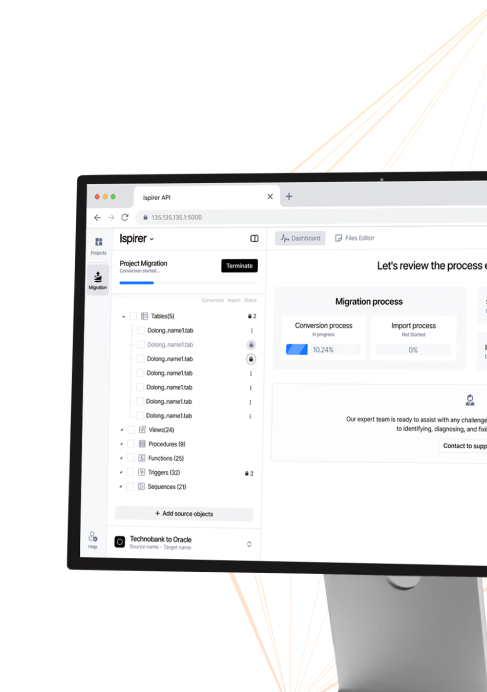
Migrate Smarter. Evolve Faster
Over 150 migration directions- PostgreSQL
- Oracle
- AlloyDB
- SQL Server
- Informix
- MySQL
- DB2
- MariaDB
- Sybase ASE
- PostgreSQL
- Oracle
- AlloyDB
- SQL Server
- Informix
- MySQL
- DB2
- MariaDB
- Sybase ASE
- MSSQL
- COBOL
- Azure
- Progress 4GL
- SAP
- PowerBulder
- .NET
- Delphi
- MSSQL
- COBOL
- Azure
- Progress 4GL
- SAP
- PowerBulder
- .NET
- Delphi
Designed for continuity
Every old system carries years of decisions inside it, some good, some made under pressure nobody remembers anymore. My team's job is to understand that history well enough to carry forward what actually works, instead of throwing it out and starting over. That's what I find genuinely interesting about this work: nothing gets lost just because it's old, it either keeps running or turns into something better.
 CTO, Ispirer Systems

Take your migration further: move logic from database to application layer
Database migration is often the right moment to revisit where business logic should actually live. Many Oracle systems carry years of accumulated logic inside the database – in packages, procedures, and triggers – that would perform better, scale more easily, and be easier to maintain if it lived in the app layer instead. The Oracle to SQL Server conversion process doesn't have to stop at the database boundary: Ispirer helps you convert Oracle to SQL Server logic at the application level too.
Source Database
- Oracle
ODBC
Files With Business Logic SQL Code
- Oracle

Seamless integration, limitless possibilities!
Application Target Code
- Java
- JDBC
- Spring
- Hibernate
Unlock agility: shift your database logic to the application layer!
Transform faster, scale smarter — see how moving from database to application layer drives real results. Let’s modernize it together.
The world’s most innovative companies are building their next big thing with Ispirer
Magnit, CardinalHealth, Worldline and more have adopted SQLWays to boost their innovation life-cycle accelerate and manage their end-to-end innovation lifecycle





Oracle to PostgreSQL MS SQL Server to PostgreSQL
Migration project
50%
Migration time reduction
1.365K
Lines of SQL code
8 Tb
of data
Talent Management
"Ispirer Toolkit enabled a seamless migration of 8 TB of data and 1.36M lines of code from Oracle and SQL Server to PostgreSQL. The automation features reduced migration time by 50%, cutting costs and minimizing manual effort. The quality, precision, and support exceeded our expectations."
SQL Server to PostgreSQL
Migration project
70%
Migration time reduction
650K+
Lines of SQL code
700+ tables
of data
Healthcare Solutions
"Ispirer helped us migrate 700+ tables and 650+ stored procedures from SQL Server to PostgreSQL, reducing development time by 60%-70%. The tool efficiently handled case-sensitive issues and frequent data changes. The excellent support made the process easy, fast, and effective."
Oracle 19c to PostgreSQL
Migration project
65%
Migration time reduction
1.500K
Lines of code
8 TB
of data
Payments & Financial Services
"Ispirer Toolkit helped us migrate 1.5 million lines of complex Oracle code to PostgreSQL, overcoming unique challenges with expert support. Their team provided customized solutions for a smooth transition. This migration is a key step in our cloud strategy, and we highly recommend Ispirer's services."
Informix to Oracle
Migration project
78%
Migration time reduction
200K+
Lines of code
12 TB
of data
Governmental
"Ispirer MnMTK was crucial to our successful database migration, converting 12 TB of data and 200,000 lines of SQL code. The tool outperformed other solutions, saving us countless hours. The support team was responsive and effective—money well spent."
Firebird to PostgreSQL
Migration project
55%
Migration time reduction
25K+
Lines of SQL code
> 150 tables
per database
Manufacturing & Fleet Management
"Ispirer's Toolkit enabled the efficient migration of 150 tables and 25,000 lines of code from Firebird to PostgreSQL. The tool saved us time and reduced risks, while the Ispirer team provided excellent support throughout. Highly recommended for similar database migration projects."
Sybase to MySQL
Migration project
95%
Migration time reduction
4.000+
Stored procedures
200+
tables
IT Services
"Ispirer’s tool allowed us to automatically convert 4,000+ procedures and 200+ tables from Sybase to MySQL with 95% success, saving a lot of time. The ability to customize the tool and the excellent support made the process smooth and efficient. Highly recommended!"
Migration details overview
Ispirer Toolkit handles the full conversion of Oracle database objects to Microsoft SQL Server, including schema, data, and the business logic that typically makes oracle to microsoft sql server migrations expensive and slow.
-
Two ways to migrate your database
1Allows Ispirer Toolkit to read object dependencies and schema context in real time.
recommended2Convert Oracle PL/SQL scripts without connecting directly to the source database.
-
Ispirer Toolkit migrates the following objects
views tables functions triggers procedures sequences packages collection and object typesEach is converted to its Transact-SQL equivalent, not approximated or stubbed out.
If you have your own applications, the embedded SQL and database APIs can be converted using either Ispirer Toolkit or Ispirer Service. They will be able to work with your new SQL Server database.

Tables and data conversion
Tables are migrated with complete fidelity. When you migrate data from Oracle to SQL Server, indexes, referential integrity constraints, and all records are transferred to the target database. Oracle native data types are mapped to their SQL Server equivalents using Ispirer's built-in type mapping logic, and users can override default mappings where project-specific rules require it. This level of configurability, with 300+ available parameters, is one of the reasons Ispirer consistently delivers higher automation rates than generic tools for Oracle to MSSQL migration.

Procedures and functions conversion
Oracle user procedures and functions are converted to stored procedures and functions written in PostgreSQL syntax, depending on the version of the target database. Packages are converted to a separate set of objects — procedures and functions.

Package-level variables and constants are taken into account
Package-level variables and constants are migrated to SQL Server tables, with a set of auto-generated user-defined functions (UDFs) that manage read and write operations against those tables. This approach maintains the original behavioral contract without manual intervention.

Built-in functions and procedures conversion
Where Oracle built-in functions have direct SQL Server equivalents, they are mapped precisely. Where no equivalent exists, Ispirer generates T-SQL expressions or custom UDFs that replicate the original behavior – rather than leaving unmapped stubs for developers to resolve later. This distinction matters at scale: on large Oracle codebases, thousands of built-in function calls would otherwise require individual manual review.

Working with collections and their methods
Ispirer Toolkit supports all three Oracle collection types – associative arrays, nested tables, and variable-size arrays (varrays). Each is converted to a SQL Server table structure, with a corresponding set of UDFs generated to operate on the stored values. The behavioral equivalent is preserved without requiring a redesign of the collection logic.

Oracle supplied PL/SQL package conversion
Ispirer Toolkit supports automated conversion of Oracle-supplied PL/SQL packages including UTL_FILE, DBMS_LOB, and others. The supported package list is actively expanded based on project requirements – if a specific package is critical to your migration, it can be prioritized within the customization process.
Migration demo
Check out how Ispirer Toolkit migrates databases efficiently, minimizing the need for manual corrections
6 undeniable facts to choose conversion with Ispirer
-
Reduced costs
![Reduced costs icon]()
Migrating to a more efficient Microsoft SQL Server database can lower operational costs by reducing hardware and software maintenance requirements, optimizing resource utilization, and lowering licensing fees.
-
Modernization & innovation
![Modernization icon]()
Migrating to Microsoft SQL Server can enable the adoption of new technologies and features, unlocking new business opportunities and driving innovation. It also creates room for future growth.
-
Added AI precision
![AI icon]()
An AI-driven migration toolkit can automate complex tasks, reduce errors, optimize workflows, and accelerate the process, ensuring smoother transitions while minimizing costly system downtime.
-
Enhanced security
![Enhanced security icon]()
Newer databases often incorporate advanced security features like encryption, access controls, and threat detection mechanisms, providing better protection against data breaches and cyberattacks.
-
Legacy transformation
![Legacy transformation icon]()
Migrating legacy databases to modern systems can upgrade your database, making it easier to maintain, update, and extend in the long run. This creates a more flexible foundation for future growth.
-
No need for documentation
![No documentation icon]()
We perform the migration using the source code. There is no need for detailed documentation to begin the migration as there is in development. Our tools analyze the source code and database structure automatically.


They succeeded using Ispirer Toolkit
Achieving 95% automation in PostgreSQL database migration

Project Scope
1 700 000 LoC
Project Duration
12 Months
Industry
Contingent Workforce Management
Sybase ASE to Azure SQL Database: Automated Cloud Migration for Financial Services

Project Scope
420 000 LoC
Project Duration
5 Months
Industry
Global Financial Services Provider
Power Management Company Streamlines Migration to Azure SQL Twice

Project Scope
76 tables,
15 000 LoC
Project Duration
1 month
Industry
Power Management Company
Teradata to Amazon Redshift. Ispirer Toolkit License

Project Scope
64 SQL Statements,
70 BTEQ Commands
Project Duration
2 month
Industry
Cloud Computing and Web Services Provider
Useful articles about database migration
How to Plan an Oracle Database Migration That Lands on Schedule
October 02, 2026
Oracle to PostgreSQL, Azure SQL or OCI: how to size the PL/SQL, pick a target your code fits, and run the steps in order. With a pre-migration checklist.
Oracle GoldenGate 26ai vs Ispirer IDM for Oracle-to-PostgreSQL Migrations (2026 Edition)
June 23, 2026
Compare Oracle GoldenGate 26ai vs Ispirer IDM for Oracle-to-PostgreSQL migrations.
Unlock Scalability and Innovation: Your Complete DB2 to Oracle Migration Guide

April 03, 2026
Automation by Ispirer + Expertise by Path Infotech = Your Success
PostgreSQL vs. SQL Server: What to Choose?
November 13, 2025
Two most popular databases have their strengths and weaknesses. How to choose between them? We've made a detailed comparison. Check it out:
Step-by-Step: Migrating business logic from Oracle PL/SQL to Java

June 05, 2025
Discover the real-world cases of moving business logic from Oracle PL/SQL to Java
Migrating Oracle to Azure SQL Database: All You Need to Know

October 26, 2023
How to migrate Oracle to Azure SQL Database? What tools can optimize this process? Check all the details in the article:
Take control of your database migration now
Consult with our expert to better organize for you migration flow.
Frequently Asked Questions
Find answers. Ask questions. Connect with Ispirer support.
Want more details?
Request a consultation with our expert
Are there any tools that can simplify the migration process from Oracle to SQL Server, including PL/SQL conversion?
Yes. One of the products that stands out on the market is Ispirer Toolkit, which converts Oracle schema, data and PL/SQL into SQL Server objects and T-SQL. SQL Server Migration Assistant is a free alternative that works for simpler schemas.
Automation removes the repetitive part of the work: type mapping, DDL generation, data transfer and the bulk of procedural code. Decisions remain for the code that has no direct target construct.
REF CURSOR output parameters become procedures returning result sets directly, which also changes the application data access layer. Packages become schemas with separate procedures. Sequences with BEFORE INSERT triggers become IDENTITY columns or SQL Server sequences. Autonomous transactions become a separate connection or a logging service.
On the query side, CONNECT BY becomes a recursive CTE, ROWNUM becomes TOP or ROW_NUMBER(), and DUAL disappears. When business logic also lives in application code, CodeWays converts the embedded SQL and database API calls so the application matches the new database.
Can I migrate data from Oracle to SQL Server easily, or are there data type and NULL handling risks?
Yes, the data transfer itself is a routine operation, but three risks decide whether the result is correct.
First, DATE columns must land in datetime2(0) and not date, otherwise the time component is dropped without a warning. Second, NUMBER without declared precision must be checked against actual values before it becomes decimal(38, n) or float, because a wrong choice either truncates values or changes rounding in financial calculations. Third, Oracle stores an empty string as NULL, so every IS NULL check and every constraint that relied on that behavior needs review.
Remaining mappings are NVARCHAR2 to nvarchar to keep multibyte data intact, CLOB to nvarchar(max), BLOB to varbinary(max), RAW to varbinary.
Validate after the load with row counts, column checksums and boundary values for numeric and date columns. SQLWays by Ispirer applies the type mapping across the whole schema and reconciles record counts during transfer, so discrepancies appear before sign off rather than in production.


