
Data Migration Tools for Healthcare Data and the Challenges They Help Address
Summary: This article looks at data migration tools used in Healthcare projects, explains how they differ, outlines what to consider when choosing a migration tool, and describes the main steps for preparing data and processes before migration.

Healthcare data migration sits at the intersection of IT, clinical operations, and regulation. It is rarely limited to a simple system change and often affects how care is delivered, documented, and audited. The data migration tools for healthcare data become central control points, influencing how safely and predictably the transition can be executed.
What makes Healthcare migration different
Unlike many other industries, healthcare works with long-lived, highly connected data sets. Patient records are created, updated, and referenced over many years, often across multiple systems. Any migration effort must account for this complexity before technical work even begins.
Data structure and volume
Healthcare organizations operate at significant data scale, with EHR and EMR systems holding large volumes of both structured data, such as codes and results, and unstructured content, including notes, documents, and images. Legacy formats and proprietary schemas make accurate data mapping a non-trivial task.
Security, compliance, and accuracy
Patient data is highly sensitive and strictly regulated. During migration, information must remain protected and auditable, while data accuracy is preserved despite differences in how systems represent clinical concepts. Losing metadata, identifiers, or record relationships can have both regulatory and clinical consequences.
Interoperability and operational impact
Healthcare systems rarely function in isolation. They connect to labs, pharmacies, imaging systems, billing platforms, and external exchanges. Migration requires these integrations to be rebuilt and validated, often under tight uptime constraints. Poorly planned transitions can disrupt workflows and delay access to patient information.
What to look for in Healthcare data migration tools
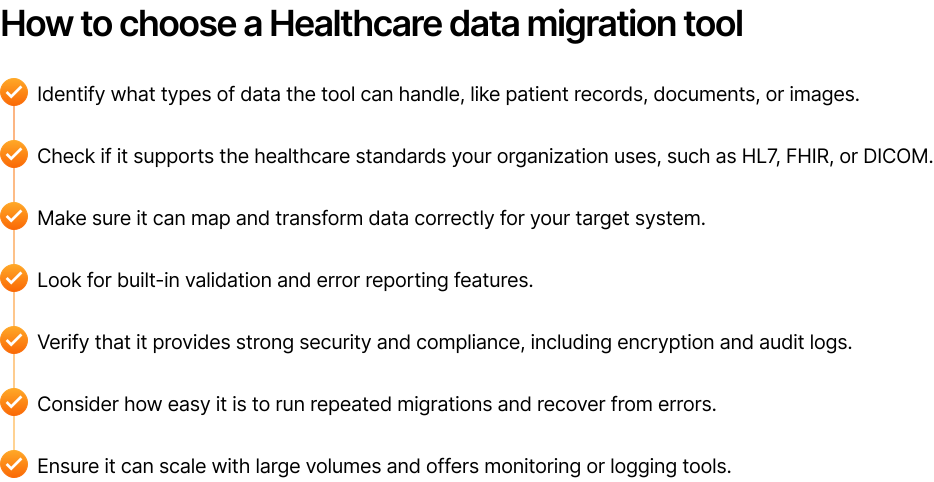
Start with the types of data it can move
Not all migration tools are suitable for healthcare environments. Some handle structured data like patient records well, while others struggle with documents or medical images. For that reason, when evaluating data migration tools for healthcare data, it is important to confirm early on that they can process all required data types and preserve critical information throughout the migration.
Make sure it supports the right healthcare standards
Healthcare systems depend on shared standards to exchange data reliably. If your organization works with HL7, FHIR, DICOM, or similar formats, the medical data migration tool should support them natively. This level of compatibility reduces integration complexity and helps maintain data accuracy in the target system.
Evaluate data mapping and transformation capabilities
Even when standards are in place, source and target systems rarely share identical data structures. Fields may be organized differently or require conversion to new formats. A reliable hospital data migration tool should therefore provide flexible mapping and transformation options that allow data to align with the target system without extensive manual effort.
Pay attention to validation and error reporting
As data moves between systems, inconsistencies and errors can appear. Built-in validation helps identify missing or incorrect information early in the process. Clear error reporting then enables developers to resolve issues quickly and prevents problems from reaching downstream systems.
Security and compliance should be part of the core design
During migration, patient data is exposed to additional risk if safeguards are weak. The tool should include encryption, role-based access controls, and audit logging as standard capabilities. Strong security support is essential for meeting regulatory requirements and internal governance policies.
Consider how it handles repeated migrations and recovery
Migration is rarely a single, linear activity. Test runs, phased deployments, and incremental updates are often required. A suitable tool should support repeatable executions and allow recovery from partial failures without restarting the entire workflow.
Think about scalability and monitoring
As migration progresses, data volumes can quickly grow. The migration tool should scale reliably and offer monitoring or logging features that provide visibility into progress and performance during execution.
Exploring Healthcare data migration solutions
Healthcare data migration is supported by a range of specialized tools, each built around a specific technical approach. Some products work at the database level and support long-running migrations with minimal downtime. Others are designed to move data into a predefined EHR model with strict validation rules.
Ispirer Data Migrator
Ispirer Data Migrator is designed for large-scale database migrations where systems need to remain operational during the transition. Instead of relying on a single bulk load, it migrates data in stages and keeps source and target databases synchronized until final cutover.
This model is commonly used in healthcare environments with large clinical datasets and limited downtime windows. From a technical standpoint, the absence of middleware and the use of read-only access simplify deployment and reduce operational risk.
Key features
- Phased migration with continuous data synchronization
- Near-zero downtime cutover
- Direct database-to-database migration without middleware
- Support for large tables and binary data
- Automated schema and data conversion
Simplify your next Healthcare data migration
Let our experts design a safe migration roadmap tailored to medical data regulations
Meddbase Data Migration Toolkit
The Meddbase Data Migration Toolkit is built specifically for migrating data into the Meddbase EHR platform. Rather than migrating entire databases, it focuses on importing data into an existing application schema with predefined validation rules.
This approach is useful when accuracy and control are more important than speed. Validation reports and rollback mechanisms allow teams to run migrations iteratively without risking corruption of production data.
Key features
- Targeted data import into the Meddbase EHR data model
- Pre-import validation and reporting
- Rollback support for failed or incorrect imports
- Migration of patient records, documents, and images
- API-based ingestion for advanced scenarios
Hart Health IT: HealthMigrate and HealthExtract
HealthMigrate and HealthExtract are products focused on one-time EHR data migration and full data extraction from legacy systems. They are typically used during EHR replacements or large consolidation projects where historical data must be transferred completely.
These healthcare data migration tools handle both structured clinical data and unstructured content such as documents and images, which is often required when migrating long-lived patient records.
Key features
- One-time migration of clinical and financial EHR data
- Full extraction of discrete and non-discrete data
- Vendor-agnostic support for multiple EHR platforms
- Preservation of documents and image data
- Designed for regulated healthcare environments
Solix EHR Data Migration
Solix EHR Data Migration is designed to move healthcare data out of legacy systems into modern platforms or archives. It is commonly used in modernization and consolidation initiatives where historical data must remain accessible after system changes.
The product emphasizes structured extraction and transformation, which helps reduce inconsistencies when working with older systems and heterogeneous data models.
Key features
- Migration of EHR and EMR data from legacy systems
- Structured data extraction and transformation
- Secure handling of clinical information
- Support for large historical datasets
- Integration with broader data management workflows
Astera Data Pipeline
Astera Data Pipeline is a general-purpose data migration and integration product that is often used in healthcare projects for its flexibility. It allows teams to build and manage migration pipelines visually while still supporting complex transformation logic.
In healthcare scenarios, it is typically used when data needs to be moved across multiple systems or consolidated into analytics platforms rather than migrated into a single EHR.
Key features
- Visual ETL and data migration pipelines
- Automated data mapping and transformation
- Support for structured and semi-structured data
- Monitoring and error handling for migration workflows
- Scalable execution for large data volumes
Preparing your data and process for Healthcare migration
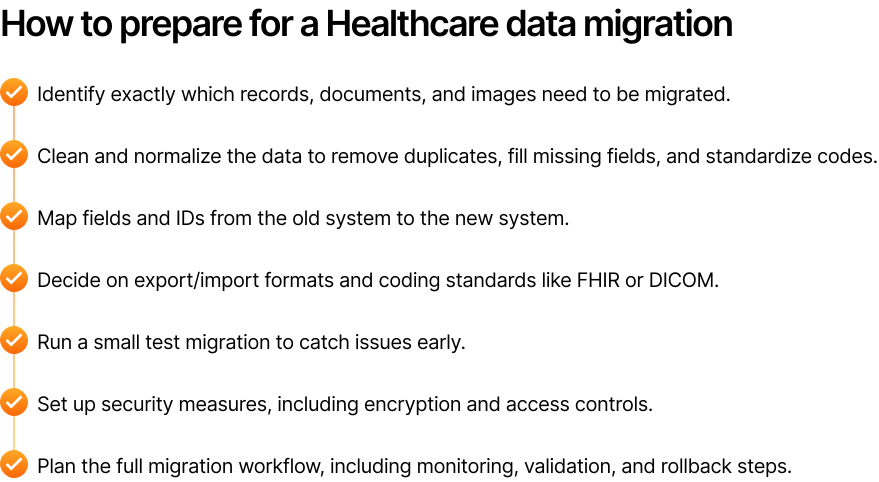
- Define the migration scope
- Clean and normalize the data
- Map fields and identifiers between systems
- Choose formats and standards early
- Test the migration on a limited data set
- Put security measures in place
- Plan how the migration will run
Start by deciding which records, documents, and images should move to the new system. Migrating outdated or low-value data adds volume and slows down validation, while rarely improving results.
Most legacy systems contain duplicates, gaps, and inconsistent codes. Addressing these issues before migration reduces the amount of transformation work later and helps avoid unexpected behavior in the target system.
Data structures and identifier logic often differ between systems. Patient IDs, references, and relationships need to be aligned carefully so records remain connected after migration.
Export and import formats should be defined before any data is moved. Decisions around standards such as FHIR or DICOM affect how data is transformed and validated throughout the process.
A small test run makes it easier to spot mapping issues, data inconsistencies, and structural gaps. Fixing them at this stage prevents larger problems during the full migration.
Security controls should be part of the initial setup, not an afterthought. Encryption, access restrictions, and secure transfer methods must be applied consistently during migration.
Define how the process will be monitored, validated, and rolled back if needed. Clear execution rules reduce uncertainty when issues appear during migration.
We can support developers facing healthcare data migration challenges, offering guidance on best practices for data cleaning, normalization, and mapping. Our expertise helps reduce risks and navigate the process more confidently.
Simplify your next Healthcare data migration
Let our experts design a safe migration roadmap tailored to medical data regulations
Bringing it all together
Healthcare data migration tools play a key role in handling complex data structures, standards, and security requirements. When used correctly, they help keep migrations predictable and reduce the amount of manual work involved.
At the same time, good results come from combining the right tool with clear data scope and a well-planned migration process.
Do you have a migration project ahead?
Talk to expert. Save your time


