

Security Hardening Services
Strengthen infrastructure, cloud environments, remote access systems, endpoints, and security processes before vulnerabilities turn into incidents
Common security challenges
Security Hardening is typically requested when organizations already understand that certain areas create operational or security risk. Typical situations include:

Infrastructure

Identity management

Security findings

Governance
-
Cloud security
Cloud environments were deployed without security standardization
-
Remote access
VPN, firewall, and remote access controls require strengthening for remote work
-
Endpoint security
Endpoint protection controls require strengthening to reduce risk
-
Migration impact
Infrastructure changed after migration or modernization projects
-
MFA management
MFA is implemented inconsistently across critical systems and applications
-
Access control
Excessive permissions accumulated over time without review
-
Assessment findings
Assessments identified security or configuration weaknesses
-
Pen test results
Penetration testing identified exploitable weaknesses
-
Operational risks
Operational security concerns require corrective action
-
Security governance
Security processes became inconsistent as the company scaled
-
Limited resources
Internal IT teams lack resources to complete remediation and hardening activities
-
Audit readiness
Preparing for investment, acquisition, due diligence, customer-driven security audit or certification audit
-
Compliance requirements
Preparing to meet customer, regulatory, and industry security requirements while reducing compliance risks
Security Hardening helps organizations:
Industries where Security Hardening plays a critical role
While system hardening is a standard security practice across organizations of all types, it is particularly critical in the following industries due to their heightened security, compliance, and operational requirements.
-
![Finance icon]()
Finance
-
![Healthcare icon]()
Healthcare
-
![Insurance icon]()
Insurance
-
![Tech and SaaS icon]()
Tech and SaaS
-
![Retail icon]()
Retail
-
![Manufacturing icon]()
Manufacturing


Areas covered by Security Hardening services
Security Hardening services are organized into key domains, each covering specific security controls, configuration improvements, and operational best practices.
Identity and access management hardening
Authentication hardening (Microsoft Entra ID, AD)
Identity and access governance
Privileged access hardening
Conditional access hardening (Microsoft Entra Conditional Access)
Cloud and SaaS security hardening
Cloud security improvements
SaaS security hardening
Network security and remote access hardening
Firewall hardening
VPN and remote access hardening
Network segmentation
Wireless security hardening
Network access control hardening
DNS and web security hardening
Endpoint security hardening
Endpoint protection improvements
Endpoint hardening
Disk encryption
Patch and update management improvements
Resilience and recovery hardening
Business continuity readiness improvements
Disaster recovery hardening
Backup and recovery hardening
Backup governance and processes improvement
Operational security hardening
Vulnerability management improvements
Logging and monitoring improvements
Incident response readiness
Asset visibility and security inventory
Operational security process improvements
Security control standardization
Related security services
Complement your Security Hardening initiative with additional services that help identify vulnerabilities, strengthen resilience, and maintain long-term security.
Security assessment
Assess your infrastructure for security risks and vulnerabilities

Penetration
testing
Identify vulnerabilities through real-world attack simulation

Virtual security advisor
Get continuous guidance to strengthen your security posture

How Security Hardening is performed
Every Security Hardening engagement is tailored to the organization's environment, priorities, and operational requirements to ensure effective implementation with minimal business disruption.
-
Tailored approach
Security Hardening is planned individually for each organization based on its infrastructure architecture, cloud and remote access environment, operational requirements, existing technologies, and remediation priorities.
-
Flexible scoping
The implementation scope may be defined using the results of a Security Assessment or Penetration Testing, based on client-defined requirements, or through a preliminary scoped technical review when additional clarification is needed.
-
Controlled execution
Implementation activities are planned and coordinated with the client’s team, taking into account technical dependencies, available resources, operational constraints, and business requirements. This approach helps minimize disruption to production systems and day-to-day operations.
![Controlled execution]()
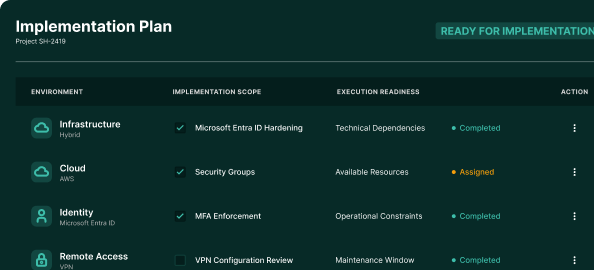
Security Hardening process
End-to-end implementation workflow
-
Initial review and scope analysis
Review of existing findings from Ispirer Security Assessment, third-party assessments, penetration testing results, client-provided findings, requested hardening activities, and operational concerns. When additional clarification is required, a focused technical review is conducted to define the remediation scope, implementation priorities, and required activities.
SCOPE CONFIRMED -
Scope definition and planning
Definition of implementation scope, priorities, operational constraints, and remediation sequencing.
PLAN APPROVED -
Coordination and preparation
Coordination of technical access, implementation windows, responsible stakeholders, and operational dependencies.
ENVIRONMENT READY -
Security hardening implementation
Implementation of agreed hardening activities, configuration improvements, access control remediation, and operational security enhancements.
HARDENING IN PROGRESS -
Validation and verification
Validation of completed remediation activities and review of implemented controls, where applicable.
CONTROLS VERIFIED -
Documentation and knowledge transfer
Preparation of implementation documentation, operational guidance, and internal security process documentation.
DOCUMENTATION DELIVERED -
Final review and recommendations
Final review discussion covering implemented changes, remaining recommendations, operational considerations, and potential next steps.
PROJECT COMPLETED
Why choose Ispirer Security Lab team
-
Focus on implementation
![Focus on implementation icon]()
Unlike advisory-only engagements, Ispirer Security Lab focuses on implementing security improvements within existing infrastructure and production environments.
![Focus on implementation icon]()
Engagement activities are planned around remediation priorities, technical dependencies, business requirements, and implementation constraints.
-
Understanding of operational environments
![Data expertise icon]()
Security Hardening is performed with consideration for existing operational workflows, infrastructure dependencies, internal IT capabilities, and day-to-day administration. Implemented controls and security improvements are aligned with the way systems are operated and managed over time.
-
Experience with complex technology environments
![Experience icon]()
Years of experience with complex enterprise systems provide a deep understanding of business applications, databases, infrastructure components, and integrations.
![Experience icon]()
We understand where security challenges emerge during modernization, migrations, infrastructure changes, and organizational growth.
-
Engineering experience built through transformation projects
![Engineering experience icon]()
Ispirer develops its own products for database and data migration, as well as code conversion, including SQLWays, Ispirer Data Migrator, and CodeWays. Through these projects, our teams regularly work with environments of different scales and complexity – where access management, configuration consistency, operational processes, and security controls often require careful review and improvement alongside the technical implementation itself.
This experience is complemented by Ispirer’s ISO/IEC 27001 certification and our own implementation of security practices within the company. We maintain established security controls, operational processes, and continuous improvement practices in our own environment.


Security Hardening pricing
Security Hardening services are provided on a time & materials basis for an agreed scope of work. Effort and timelines depend on project requirements and implementation priorities
Ispirer Security Lab insights
AWS Migration Readiness Assessment: What the Checklist Doesn't Tell You
September 09, 2026
The AWS Migration Readiness Assessment is one of the most widely referenced frameworks in enterprise cloud migration. Does it suit you?
Fintech Cloud Migration Strategy: 2026 Roadmap to Security, Speed & Compliance

December 03, 2025
Secure your fintech's future with this roadmap for cloud migration balancing speed, security, and compliance.
Top 9 Best Practices for Database Security
February 23, 2024
How to ensure database security? Read the top measures for eliminating potential cyber attacks
Frequently Asked Questions
Find answers to common questions about Security Hardening, implementation, production deployment, and ongoing maintenance
Still have questions?
Request a consultation with our expert
What is Security Hardening?
Security Hardening is the process of reducing the attack surface and security exposure of systems, cloud services, and networks by improving system configurations, strengthening access controls and authentication mechanisms, enforcing security policies, and implementing secure operational practices aligned with industry best practices.
How is Security Hardening different from Security Assessment?
Security Assessment is used to identify vulnerabilities, security gaps, misconfigurations, and areas of risk. Security Hardening focuses on implementing changes that address those findings. While an assessment answers the question of what should be improved, hardening focuses on making those improvements within the environment.
Do we need a Security Assessment before Security Hardening?
We generally recommend conducting a Security Assessment before Security Hardening, as it helps identify gaps, prioritize remediation efforts, and ensure resources are focused on the most critical areas. However, if the areas requiring improvement are already known, implementation activities can be planned and initiated directly.
How can Security Hardening be safely performed in production environments?
The safety measures for performing Security Hardening within active production environments include careful preparation and planning, adherence to change management processes, and gradual implementation.
What environments can be hardened?
Security Hardening can be applied across on-premises and cloud infrastructure, Microsoft Azure, Amazon Web Services, Google Cloud Platform, Microsoft 365, Google Workspace, network and endpoint environments, remote access solutions, firewalls, and identity and access management systems. The scope is tailored to the organization’s technology landscape, security objectives, and remediation priorities.
How long does a Security Hardening project take?
Security Hardening timelines depend on the agreed scope, environment complexity, number of systems involved, implementation priorities, and coordination requirements. Targeted hardening activities, such as specific configuration improvements or security control implementation, may take several days, while broader initiatives involving multiple systems, infrastructure areas, and operational processes are typically completed over several weeks.


