
AI-Driven Cloud Migration Services Companies: Cloud Migration Solutions for Legacy Modernization
Summary: AI-driven cloud migration services companies use automation and AI-assisted technologies to simplify infrastructure migration, application modernization, and legacy transformation. This comparison explores providers focused on complex enterprise migration projects.


Cloud migration projects often become more complex than companies initially expect and require to turn to ai-driven cloud migration services. Legacy databases, outdated applications, custom integrations, and undocumented dependencies can significantly slow down migration timelines and increase infrastructure and engineering costs.
To simplify these projects, many cloud migration providers now use AI-assisted technologies and automation during database migration, application modernization, infrastructure assessment, and migration planning. These tools help engineering teams analyze environments faster, automate repetitive tasks, identify migration risks earlier, and improve overall project efficiency.
Today, companies increasingly choose cloud migration partners not only for infrastructure expertise, but also for their ability to automate complex migration processes and support modernization of legacy systems.
What are AI-driven cloud migration services
AI-driven cloud migration services combine traditional cloud migration expertise with automation and AI-assisted technologies. These companies help organizations move databases, applications, and infrastructure workloads to cloud environments while reducing the amount of manual engineering work involved in the process.
In most cases, AI-assisted migration services include infrastructure assessment, dependency analysis, database conversion, application modernization, migration testing, and post-migration validation. Automation tools are used to speed up technical tasks that previously required large engineering teams and long project timelines.
Unlike traditional cloud consulting providers, AI-driven migration companies usually have their own migration platforms, automation frameworks, or proprietary modernization tools. Instead of performing every migration task manually, they automate large parts of database conversion, code transformation, and testing workflows.
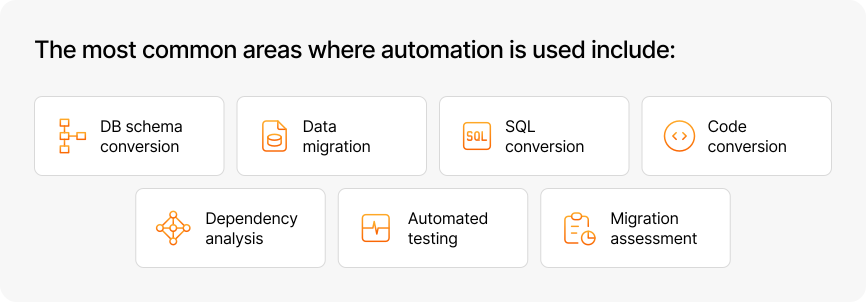
For example, automation can help analyze legacy database structures, convert stored procedures between database engines, identify unsupported SQL syntax, or validate migrated workloads before production deployment. AI-assisted analysis is also useful for detecting hidden dependencies inside large enterprise applications and planning modernization strategies for complex systems.
This approach is especially valuable for organizations working with legacy platforms, high-load databases, or business-critical applications where downtime and migration errors can create serious operational risks.
Why work with a company that uses AI for cloud migration
Faster migration projects
Automation helps reduce the amount of manual work required during migration projects. Engineering teams can complete database schema conversion, SQL transformation, dependency mapping, testing, and validation much faster compared to fully manual migration approaches.
AI-assisted analysis also speeds up migration assessment and planning. Instead of spending weeks reviewing infrastructure and legacy systems manually, migration teams can identify compatibility issues and migration requirements earlier in the project lifecycle.
Lower migration costs
Cloud migration projects often become expensive because of repetitive engineering tasks and long validation cycles. Automation helps reduce the number of manual operations required for database conversion, code migration, testing, and troubleshooting.
Another advantage is the reduction of post-migration fixes. Automated validation and testing help identify issues before production rollout, which lowers support and maintenance costs after migration completion.
Better work with legacy systems
Legacy environments are one of the biggest challenges in enterprise cloud migration. Older databases and applications often contain outdated technologies, undocumented logic, and tightly connected dependencies.
AI-assisted migration tools help engineering teams analyze legacy systems faster and build more accurate migration strategies. This is especially important for companies running large enterprise databases, monolithic applications, or older business platforms that require gradual modernization.
Reduced migration risks
Migration errors can lead to downtime, data inconsistencies, performance problems, and business disruptions. Companies that use AI-assisted migration technologies can automate dependency analysis, validation, and migration testing to detect problems before production deployment.
Many providers also support near-zero downtime migration approaches for critical systems where business interruptions are unacceptable.
Easier modernization
Modern cloud migration projects are no longer limited to infrastructure transfer. Many companies use migration as an opportunity to modernize applications, upgrade database engines, improve scalability, and optimize system architecture.
AI-assisted modernization tools help simplify application refactoring, code conversion, and platform transformation. This allows companies to migrate workloads to the cloud while also improving long-term maintainability and infrastructure performance.
Ispirer
Ispirer focuses on database migration, application conversion, and legacy modernization projects where automation is used to reduce manual engineering work. The company combines migration services with its own migration and modernization platforms, helping enterprises accelerate cloud transformation projects and simplify complex legacy migrations.
The company works with organizations that need to migrate databases, modernize legacy applications, or move business-critical workloads to cloud environments such as AWS, Azure, Google Cloud, and Oracle Cloud. Its approach is centered around automating repetitive migration tasks while keeping engineering teams focused on validation, optimization, and modernization strategy.
One of Ispirer’s main products is SQLWays, a platform designed for heterogeneous database migration and SQL conversion. It supports migration of:
- Tables
- Stored procedures
- Functions
- Triggers
- Views
- Packages
- User-defined types
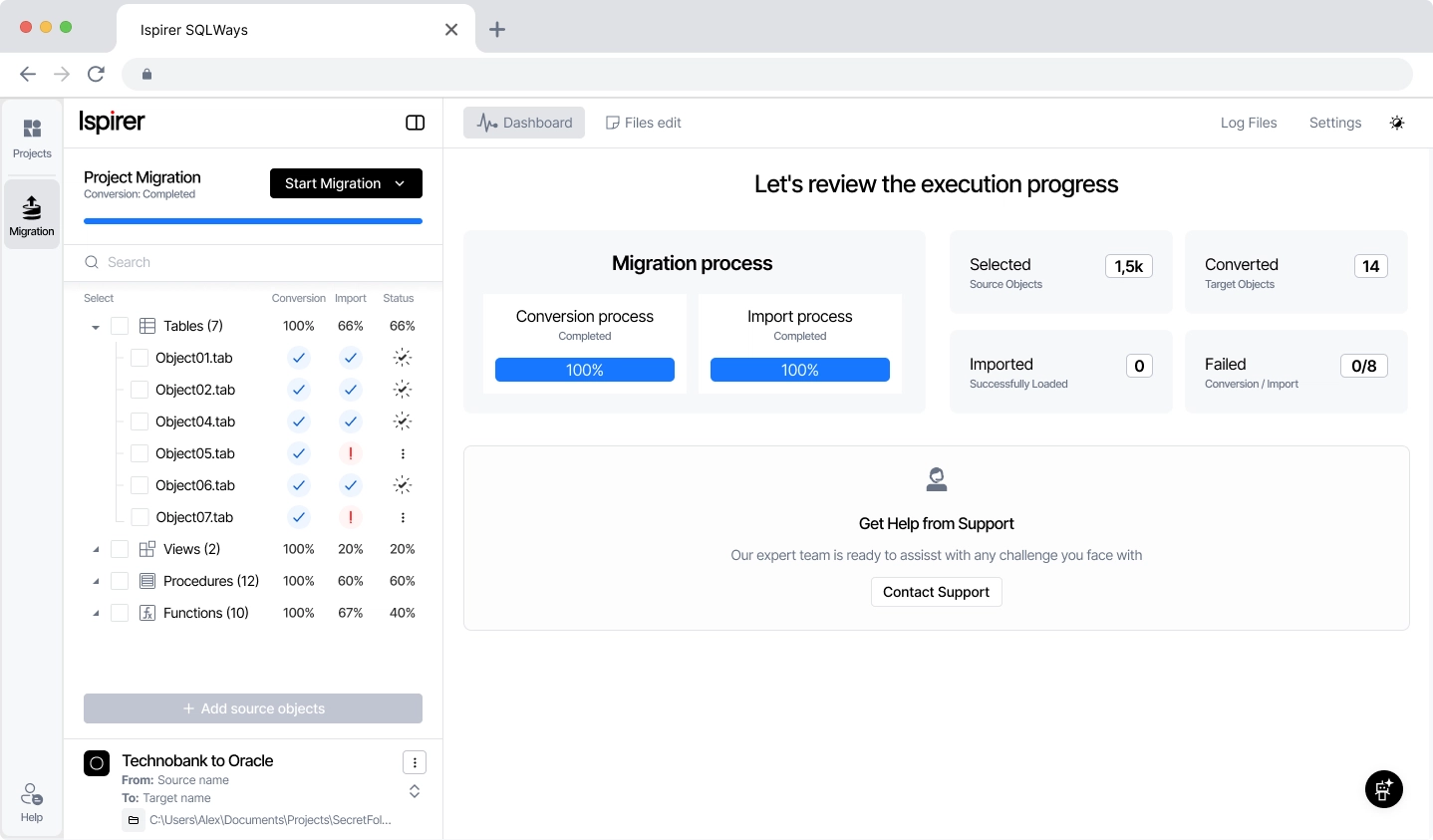
The platform also includes automated dependency handling, data type mapping, migration reporting, object name mapping, and built-in query testing. According to the company, SQLWays supports Windows, Linux, Unix, on-premises, and cloud environments.
Ispirer also integrates AI-assisted capabilities into the platform. Its Gemini-based assistant helps engineers with:
- Error handling
- Optimization suggestions
- Code refactoring
- Documentation generation
For enterprise data transfer projects, the company offers Ispirer Data Migrator (IDM). The platform is designed for near-zero downtime migration and continuous synchronization between source and target systems using Change Data Capture (CDC).
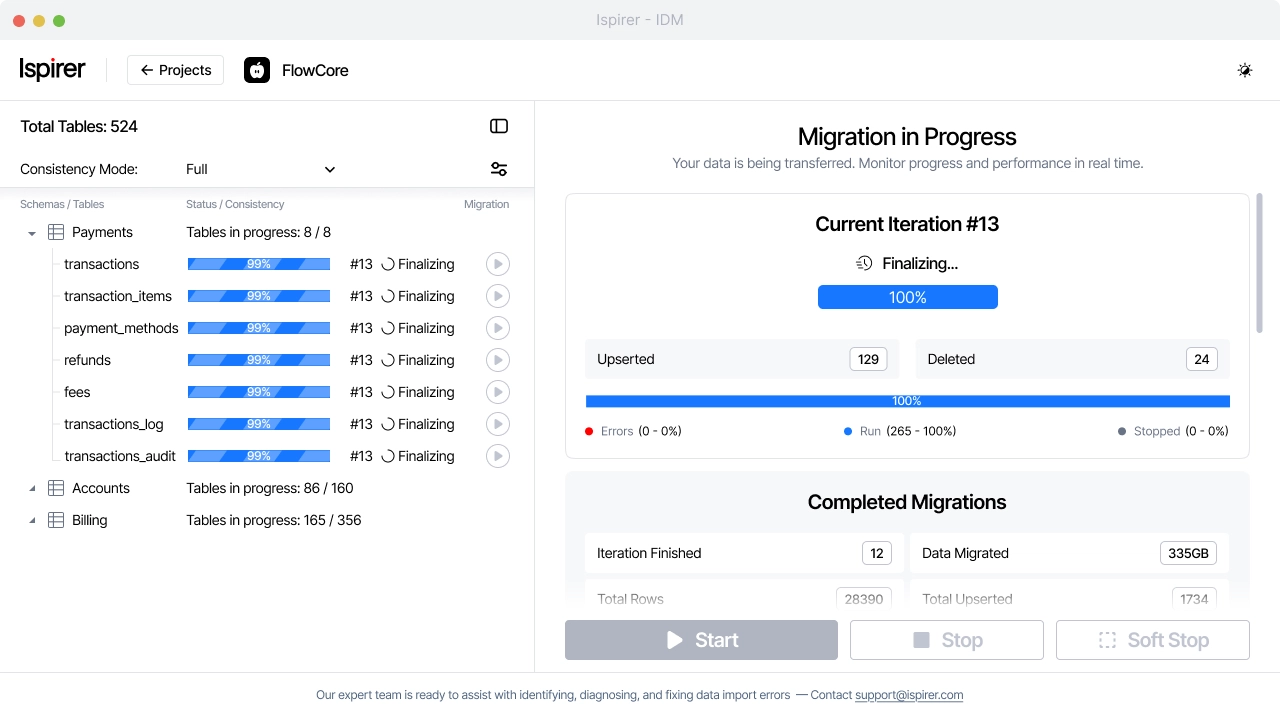
The solution supports:
- Parallel data loading
- Replication
- Fault tolerance
- Binary data transfer
- Speed throttling
IDM is positioned for high-load enterprise systems such as payment platforms, healthcare infrastructure, logistics systems, warehouse management platforms, and billing environments where downtime can create operational risks.
Another important part of the company’s portfolio is CodeWays, which focuses on automated application modernization and code conversion. The platform supports legacy technologies including COBOL, Delphi, Informix 4GL, PowerBuilder, Oracle Forms, Progress 4GL, and C/C++.
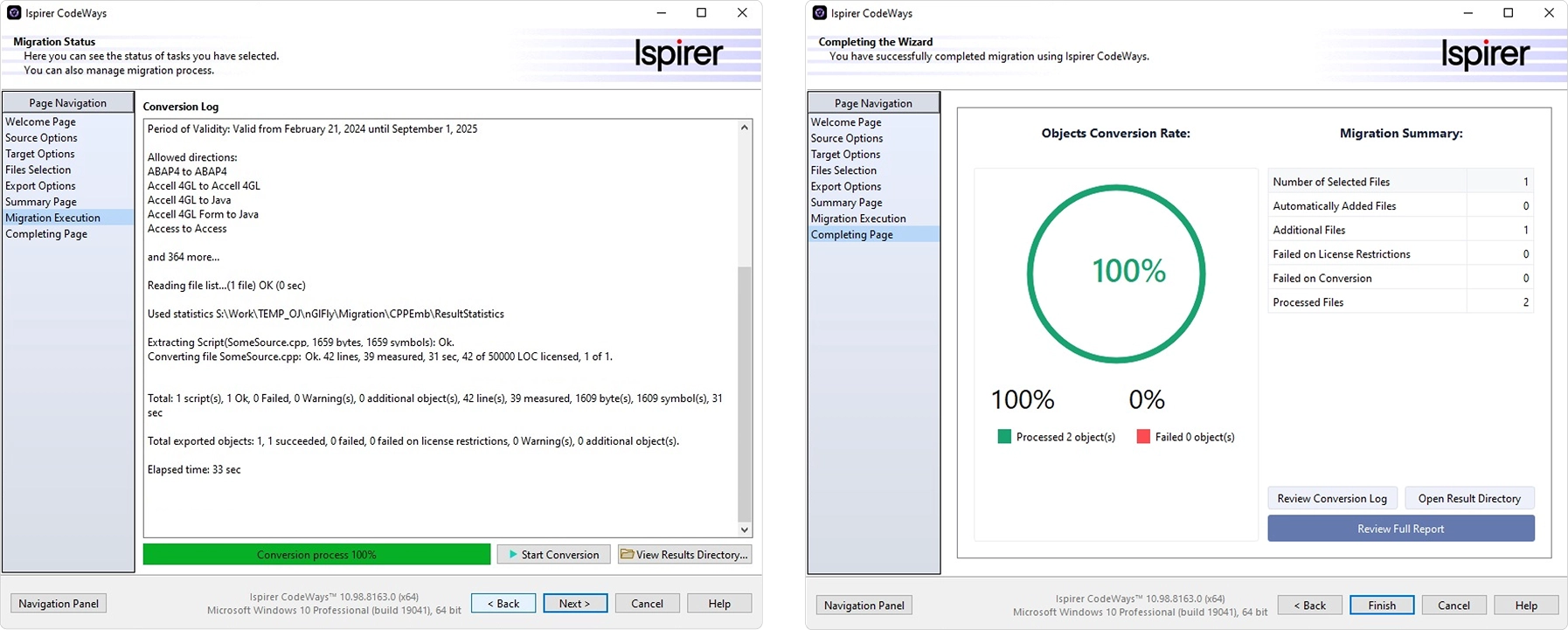
In addition to language conversion, CodeWays can modernize desktop applications into web-based architectures and convert embedded SQL and database APIs. According to Ispirer, automation can increase conversion productivity from roughly 300–400 lines of code per day with manual work to 3K–5K lines per developer per day.
Companies usually choose Ispirer for projects where manual migration would be too time-consuming or expensive. The company has a strong focus on automation for complex enterprise migrations, customizable conversion rules, legacy modernization, and secure read-only migration approaches for large production databases.
Astadia
Astadia is a cloud migration and legacy modernization company focused on enterprise mainframe environments. The company is known for working with COBOL applications, IBM systems, and large legacy infrastructures that require gradual modernization and cloud transformation.
Astadia combines migration consulting with AI-assisted analysis and automation technologies that help organizations better understand complex legacy environments before migration begins. This approach helps reduce migration risks and improves planning for large-scale modernization projects.
The company supports migration to AWS and Azure and works with industries where system stability and compliance are critical, including finance, insurance, healthcare, and government sectors.
Its services include:
- Mainframe modernization
- Cloud migration planning
- Legacy application assessment
- Dependency analysis
- Application replatforming
- Infrastructure transformation
One of Astadia’s key strengths is its experience with enterprise systems that have been running for decades and contain tightly connected business logic. Instead of replacing everything at once, the company often focuses on phased modernization strategies that allow businesses to continue operating during migration.
AI-assisted analysis tools are used to identify dependencies between applications, databases, and infrastructure components. This helps engineering teams estimate modernization complexity, detect compatibility issues earlier, and reduce unexpected problems during migration.
The company also emphasizes operational continuity during migration projects. For organizations running business-critical workloads, minimizing downtime and preserving application stability are often more important than migration speed alone.
Trianz
Trianz provides cloud migration, infrastructure modernization, and digital transformation services for enterprise organizations. The company focuses on helping businesses move workloads to cloud environments while improving scalability, operational efficiency, and infrastructure management.
A major part of Trianz’s approach is the use of AI-based assessment and automation during migration planning and infrastructure analysis. The company uses automation tools to evaluate workloads, analyze dependencies, and identify the best migration strategy before implementation begins.
Trianz supports multi-cloud environments and works with platforms such as AWS, Microsoft Azure, and Google Cloud. Its migration projects often combine infrastructure migration with modernization initiatives, allowing companies to optimize applications and operations during cloud transition.
The company’s services include:
- Cloud migration
- Infrastructure modernization
- Cloud operations
- Migration assessment
- Infrastructure automation
- Application modernization
Trianz also focuses on operational management after migration. In addition to moving workloads to the cloud, the company helps organizations automate cloud operations, improve resource management, and optimize infrastructure costs.
Another area where Trianz emphasizes automation is migration assessment. AI-assisted analysis helps identify performance bottlenecks, unsupported dependencies, and infrastructure risks before migration starts. This can reduce delays and simplify planning for large enterprise environments with multiple interconnected systems.
The company works with enterprises across industries including healthcare, banking, manufacturing, retail, and technology, especially in projects where cloud migration is tied to broader modernization and operational transformation goals.
CloudMile
CloudMile provides cloud migration, cloud-native infrastructure, and AI integration services for companies modernizing their IT environments. The company focuses on helping organizations migrate workloads to scalable cloud platforms while improving infrastructure performance and data operations.
CloudMile works primarily with AWS and Google Cloud environments and combines migration services with analytics, automation, and cloud optimization expertise. Its projects often include infrastructure transformation, data platform migration, and modernization of enterprise applications.
The company’s services include:
- Cloud migration
- Infrastructure optimization
- Cloud-native architecture
- Migration strategy
- Data and analytics modernization
- AI integration services
One of CloudMile’s strengths is its focus on cloud-native environments rather than simple lift-and-shift migration. The company helps businesses redesign infrastructure and workloads to better fit scalable cloud architectures and modern operational models.
CloudMile also uses automation and AI-assisted analysis during infrastructure assessment and migration planning. This helps engineering teams identify resource dependencies, optimize cloud configurations, and reduce operational inefficiencies after migration.
The company is often involved in projects where organizations want to combine cloud migration with data analytics modernization, AI adoption, or infrastructure optimization initiatives.
TSRI (The Software Revolution Inc.)
TSRI (The Software Revolution Inc.) specializes in legacy application modernization, platform migration, and automated software transformation projects. The company focuses on helping organizations modernize outdated applications and migrate enterprise systems to newer architectures and cloud environments.
TSRI is known for using automation and AI-assisted refactoring technologies to reduce the amount of manual work required during large-scale modernization initiatives. Its approach is particularly relevant for organizations that still rely on legacy applications built on outdated programming languages and platforms.
The company’s services include:
- Legacy application modernization
- Platform migration
- Automated code refactoring
- Software reengineering
- Cloud migration support
- Application transformation
A major focus area for TSRI is modernization of government and enterprise systems where replacing applications from scratch would be too expensive, risky, or time-consuming. Instead, the company automates parts of the code transformation process while preserving existing business logic.
TSRI’s automation technologies are used to analyze application structures, identify dependencies, and transform legacy code into modernized environments. This helps reduce migration complexity and accelerates modernization timelines for large enterprise systems.
The company also emphasizes long-term maintainability after migration. In many projects, the goal is not only to move applications to modern infrastructure, but also to make the software easier to support, update, and scale in the future.
Final thoughts
AI and automation are becoming increasingly important in cloud migration projects, especially for organizations working with large databases, legacy applications, and complex enterprise infrastructure. Automated assessment, dependency analysis, testing, and code conversion help reduce manual work and accelerate migration timelines.
At the same time, enterprise cloud migration still requires strong engineering expertise and project-specific customization. Even advanced automation platforms cannot fully replace architecture planning, validation, optimization, and migration strategy development for complex environments.
Companies like Ispirer focus heavily on automation for database conversion, data migration, and legacy application modernization, while providers such as Astadia, Trianz, CloudMile, and TSRI combine cloud migration services with modernization and AI-assisted analysis capabilities.
For enterprise organizations, some of the most important factors during migration remain security, downtime control, compatibility, scalability, and long-term maintainability after cloud adoption. Companies that combine migration expertise with automation technologies are often better positioned to handle these challenges in large-scale transformation projects.
Do you have a migration project ahead?
Talk to expert. Save your time


