
AI Code Conversion vs Ispirer CodeWays: When to Trust a Neural Network, and When to Use a Specialized Tool
Summary: AI code conversion tools like Copilot, Cursor, Claude, and Gemini Code Assist are now standard parts of migration projects, but they carry real risks around security and library semantics. This article covers what these tools do well, where they tend to fail, and why teams migrating obsolete systems such as COBOL or PowerBuilder often turn to a specialized tool like Ispirer CodeWays instead.

Using AI tools for code conversion is worth doing, but with a few precautions in mind:
- Don't trust the translation blindly. The working model isn't simply using AI to convert code while a human signs off — it's a loop where the model checks itself through compilation and tests, and a human does the final validation.
- Security review is non-negotiable. Pay particular attention to code handling authentication, database access, and cryptography — that's exactly where a code convert AI tends to make the most systematic mistakes.
- Start small. Isolated modules with few dependencies are the best candidates for automated conversion; a tightly coupled monolith should be broken apart beforehand.
- Check library semantics by hand. Matching syntax doesn't guarantee matching behavior of third-party dependencies. That has to be validated separately.
- Be skeptical of "% success" metrics. Automated evaluation pipelines can be wrong themselves, so final numbers are worth re-checking against real tests rather than taking the report at face value.
- For critical and obsolete systems, reach for specialized tools. A general-purpose AI assistant handles modern, well-tested code just fine, and even the modernization-focused features built into Copilot, Kiro, and similar tools mostly target mainstream stacks. But for COBOL, PowerBuilder, Delphi, or another industrial old system where mistakes are costly, a specialized solution like Ispirer CodeWays, with guaranteed data safety and ready-made frameworks, is a far more predictable path than experimenting with a general model on production code.
Introduction
AI code conversion has moved past being a niche experiment for enthusiasts and become part of real migration projects. Developers increasingly ask the same questions: should you trust a neural network to port old code, what problems tend to show up along the way, and is this actually safe for production.
Here's what modern AI tools can genuinely do, where they trip up, and why complex industrial migrations often end up relying not on a general-purpose assistant but on a specialized tool like Ispirer CodeWays.
Code сonversion AI: What today's tools can actually do
A couple of years ago, this mostly meant simple line-by-line transpilers: a model that rewrote syntax from one language into another. The trend now is different.
An agentic approach has taken over, where the model works in a loop of "analyze → translate → compile → test → fix" — closer to an ongoing code AI conversation than a finished result produced in a single pass.
This is where code transformation with AI earns its keep — How it works on the mechanical side of migration:
- Syntax translation. Porting language constructs and updating outdated API calls.
- Bulk repetitive transformations. Thousands of similar functions that make no sense to rewrite by hand.
- Documenting old code. Understanding and explaining the logic matters more than rewriting it from scratch, especially once the engineers who knew the original system are long gone.
- Generating tests and helper scripts around the migration. Often this, rather than the translation itself, removes the most manual effort.
AI also performs noticeably better on isolated, loosely coupled modules (the "leaves" of the dependency graph) than on a tightly coupled monolith. The fewer external connections a component has, the higher the odds of a clean AI code convert pass.
There's no single best AI for code conversion across every stack — the right pick depends on the source language and how tightly coupled the codebase is.
Gen AI code conversion in action: A 2026 tool roundup
By 2026, developers reach for a fairly stable, if fast-moving, set of AI code conversion tools when porting or modifying code:
- GitHub Copilot. Microsoft and GitHub's tool, built into VS Code and JetBrains, with agent mode now generally available in both IDEs as of March 2026: it can autonomously decide which files to edit, run terminal commands, and iterate on build errors across a multi-file change. For migration work specifically, GitHub also ships a dedicated Copilot modernization agent that runs a full assess-plan-fix-validate workflow for upgrading .NET applications and porting them to Azure. That's closer to a purpose-built conversion tool than a general chat assistant.
- Cursor. An AI-first code editor built on VS Code that holds the context of an entire codebase and can make coordinated changes across multiple files at once. That matters when porting interconnected modules rather than isolated functions.
- Claude by Anthropic. Its strength is code explanation, review, and generation with a large context window. That helps keep a project's overall architecture in view when translating large or unfamiliar chunks of code, instead of translating file by file with no sense of the whole.
- Gemini Code Assist. Google's offering, built on Gemini models with one of the largest context windows among mainstream coding tools, integrated into Google Cloud, VS Code, and JetBrains. One thing to flag for anyone picking tools right now: as of June 2026, Google discontinued the free and individual tier of the Gemini Code Assist IDE extension and CLI, folding that experience into a new unified agent platform called Antigravity. The paid Standard and Enterprise tiers of Gemini Code Assist, with their deeper GCP integration, are unaffected.
- Kiro and AWS Transform (Amazon). Amazon's coding-assistant lineage has moved the fastest of all. Amazon CodeWhisperer became Amazon Q Developer, and Q Developer itself is now being wound down (new signups closed in May 2026, full end of support in April 2027) in favor of Kiro, a newer spec-driven agentic IDE. The part most relevant here is AWS Transform, a dedicated modernization agent now built into Kiro that handles Java, Python, and Node version upgrades, AWS SDK migrations, .NET porting off Windows, and, notably for this topic, mainframe modernization from COBOL and JCL into Java Spring Boot.
All of these are general-purpose assistants, or, in Amazon's and GitHub's case, general assistants with a bolted-on modernization module. They handle syntax and refactoring well, but, with the partial exception of AWS Transform's mainframe track, none of them were built specifically as a dedicated code converter AI for industrial-scale migration off rare or genuinely outdated languages like PowerBuilder, Informix 4GL, or Progress 4GL.
Houston, we have a problem: The limits of an AI code converter
This is the weakest part of the story right now, and it deserves an honest look — especially for teams that want to convert code AI-first. Not every code modifier AI is safe to point at production systems without a review pass.
Security
Recent data suggests that an LLM working unsupervised introduces roughly 9 times more vulnerabilities than a human developer, and these aren't random bugs. They're systematic patterns: SQL injection from missing prepared statements, use of outdated MD5/SHA1 instead of bcrypt, insecure deserialization.
Around 45% of AI-generated code contains an OWASP Top 10 vulnerability, and Java turned out to be the most problematic language, with up to 72% of generated code containing errors. There's also a documented rise in architectural holes specifically: authentication bypass and improper session handling in AI-generated code grew by 153%. This is especially risky during code conversion, since the original access-control logic can be silently lost or misinterpreted when ported to a new language.
"Locally correct, globally broken"
A model can produce code that's correct on its own but out of step with the rest of the system, and without solid code review, nobody catches it. The result is a construction that looks like it works but isn't fit for scaling or further development.
Libraries and ecosystem
The weakest point isn't language grammar. It's carrying over the semantics of third-party libraries and APIs. If the source language relies on a library with non-trivial behavior and there's no direct equivalent in the target language, the risk of silently losing functionality rises sharply.
False positives in quality evaluation
There's also a problem in the other direction. Automated evaluation pipelines for code translation often make mistakes themselves: a semantically correct translation gets flagged as failed because of a flaw in the checking pipeline, not the model. That means even a "% successful translations" metric needs to be treated with some caution.
AI code modifier or a specialized tool: Ispirer's toolset
Unlike a general-purpose AI code modifier, Ispirer was built from the ground up specifically for code migration and conversion.
The first step in Ispirer's process is Metrics, a set of tools for assessing an application before migration starts:
- Covers COBOL, PowerBuilder, Informix 4GL, Delphi, Visual Basic, Progress 4GL, and C/C++.
- Runs a thorough application assessment that estimates the period and cost of a migration project before any code gets touched.
- For source languages outside that list, Ispirer's experts can perform the assessment manually, as a separate service.
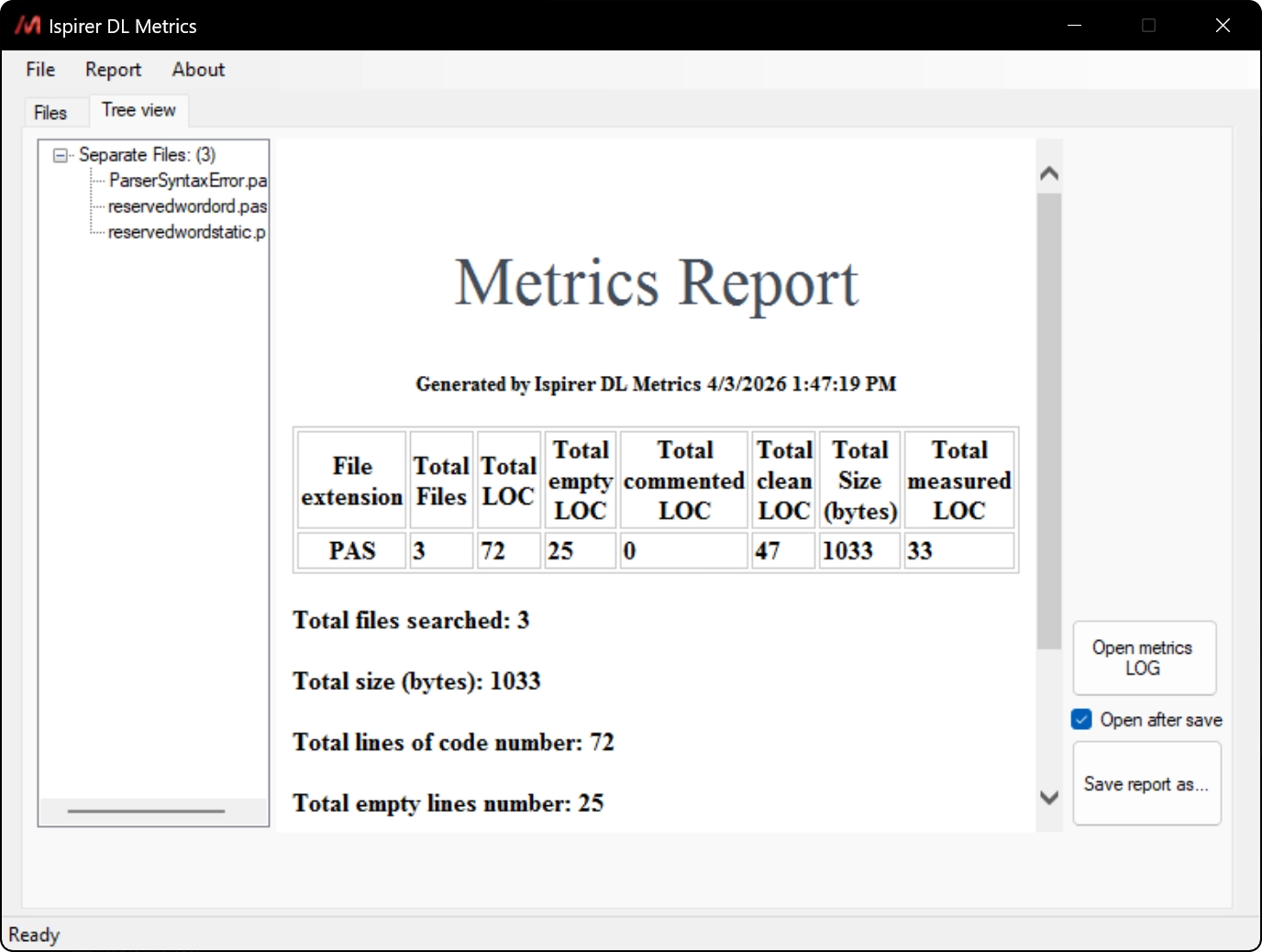
That removes the biggest risk in large migrations: uncertainty. The team gets concrete numbers before spending time on a pilot port.
Ispirer CodeWays: code transformation tool for old systems
Next comes CodeWays, the actual code conversion tool between programming languages, part of the wider Ispirer Toolkit. It automatically migrates SQL scripts, application code, and embedded SQL/database API code.
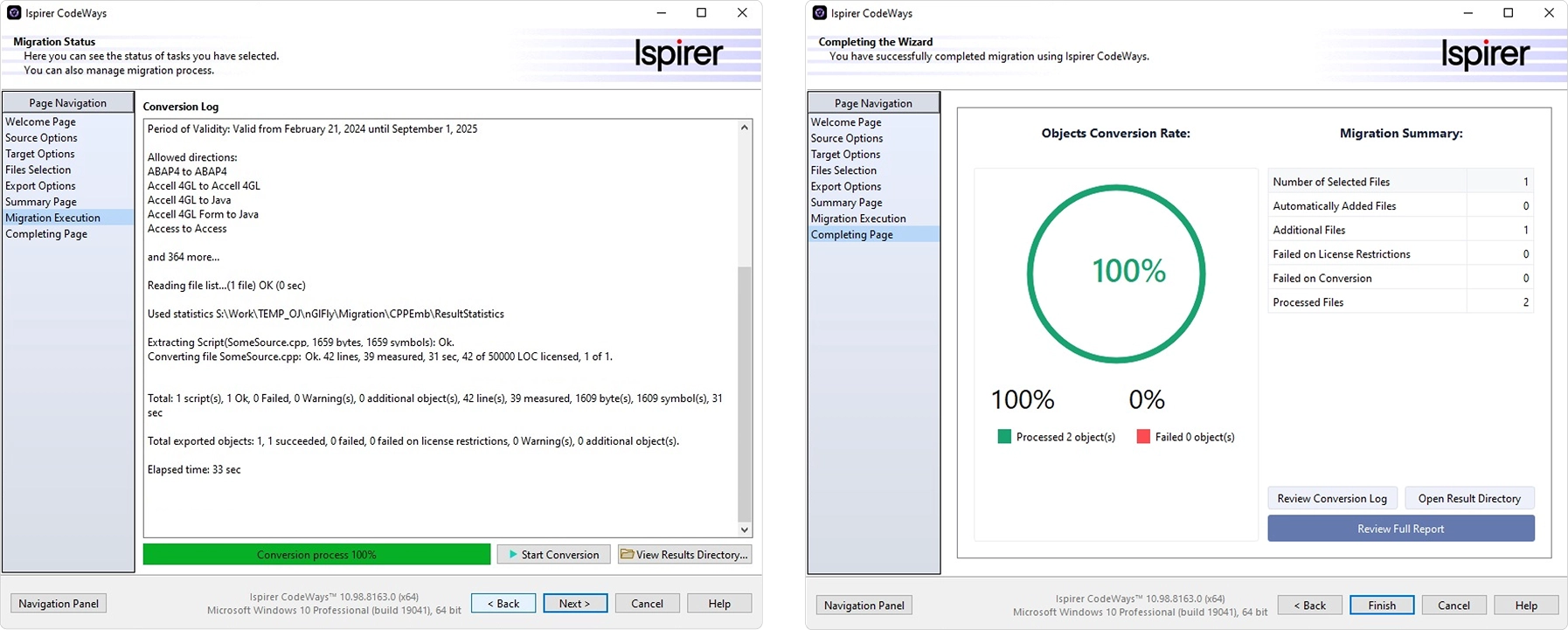
Beyond straight code conversion, it can also change an application's architecture — for example, migrating a desktop application written in Delphi, Informix 4GL, or PowerBuilder into a web-based application in JavaScript, Java, C#, Python, and other target stacks.
How it works
At the core of CodeWays is an intelligent code conversion engine that analyzes data types, relationships between objects, reserved words, and code structures that have no direct equivalent in the target technology.
That's what automates application modernization and significantly reduces migration time and associated costs, while keeping the client's involvement to a minimum. The process can still be customized: the Ispirer team adjusts the tool to a project's specifics by adding or changing conversion rules.
Data safety
CodeWays does not transfer data to third parties, does not modify the original system, and works with read-only privileges, so data safety is guaranteed throughout the process.
Ready-made frameworks
For complex migrations where the source and target technologies differ significantly, Ispirer has built special frameworks that meaningfully simplify the code the tool generates. These are available at no additional charge.
Let's plan your application migration!
Get an accurate assessment of your migration timeline, resource requirements, automation potential, and cost optimization options.
Final takeaways
Using AI tools for code conversion is worth doing, but with a few precautions in mind:
- Don't trust the translation blindly. The working model isn't simply using AI to convert code while a human signs off — it's a loop where the model checks itself through compilation and tests, and a human does the final validation.
- Security review is non-negotiable. Pay particular attention to code handling authentication, database access, and cryptography — that's exactly where a code convert AI tends to make the most systematic mistakes.
- Start small. Isolated modules with few dependencies are the best candidates for automated conversion; a tightly coupled monolith should be broken apart beforehand.
- Check library semantics by hand. Matching syntax doesn't guarantee matching behavior of third-party dependencies. That has to be validated separately.
- Be skeptical of "% success" metrics. Automated evaluation pipelines can be wrong themselves, so final numbers are worth re-checking against real tests rather than taking the report at face value.
- For critical and obsolete systems, reach for specialized tools. A general-purpose AI assistant handles modern, well-tested code just fine, and even the modernization-focused features built into Copilot, Kiro, and similar tools mostly target mainstream stacks. But for COBOL, PowerBuilder, Delphi, or another industrial old system where mistakes are costly, a specialized solution like Ispirer CodeWays, with guaranteed data safety and ready-made frameworks, is a far more predictable path than experimenting with a general model on production code.
Do you have a migration project ahead?
Talk to expert. Save your time


