
AI database migration tools vs Ispirer SQLWays
Summary: AI database migration helps analyze legacy systems, automate SQL conversion, and accelerate modernization. But enterprise migrations still require deterministic tools, validation, and controlled workflows.


Database migration has always been one of the most difficult areas of enterprise IT. Migrating from Oracle to PostgreSQL, modernizing Microsoft SQL Server environments, or moving legacy systems to the cloud involves much more than using ai database tools and transferring tables and data and.
Engineers must deal with schemas, stored procedures, triggers, views, functions, packages, SQL dialect differences, object dependencies, and business logic validation. Traditionally, these projects required large engineering teams and months of manual work.
Today, AI tools are changing this process. Developers can use AI to analyze legacy systems, rewrite SQL code, generate migration scripts, detect compatibility issues, and automate parts of testing and remediation work.
However, AI alone is not enough for enterprise-grade migration projects. The most effective approach combines AI assistants with deterministic migration platforms such as SQLWays by Ispirer.
This combination helps organizations accelerate migration while maintaining control, predictability, and security.
The main problem with database migration
The biggest challenge in database migration is not moving the schema and data itself. The real complexity comes from business logic and platform-specific behavior.
For example, when migrating from Oracle to PostgreSQL, teams often face PL/SQL incompatibilities, unsupported functions, differences in transaction handling, trigger behavior changes, package conversion issues, performance regressions, and dependency conflicts.
Even modern AI models cannot fully guarantee that converted code will behave exactly like the original system.
That is why successful migration projects still require experienced engineers, controlled conversion processes, validation, testing, and deterministic migration tools.
AI helps accelerate the work, but engineering expertise remains critical.
AI tools used in database migration projects
Modern database migration projects rarely rely on a single tool. Most developers combine AI assistants, code generation platforms, and migration utilities to handle different stages of the migration lifecycle.
Some tools help engineers understand legacy systems. Others accelerate SQL conversion, automate testing, or simplify remediation after migration. Using several tools together helps reduce manual work and shorten migration timelines.
Cursor
Some engineering teams use Cursor during migration projects that involve large legacy repositories with thousands of SQL objects, procedures, scripts, and application dependencies.
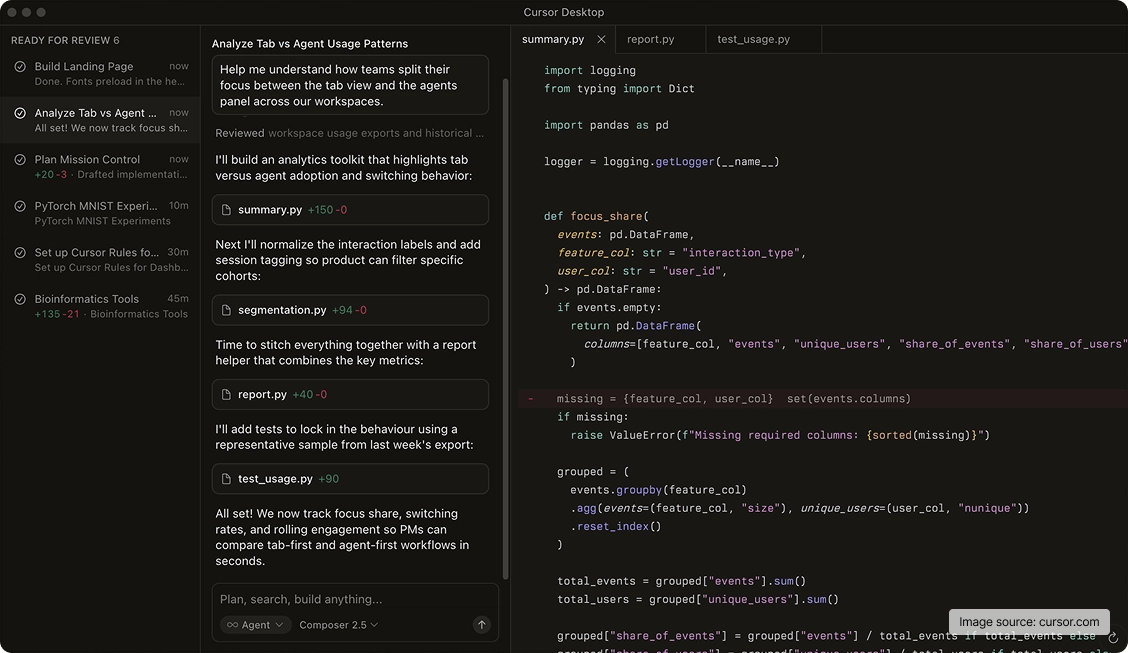
Developers use Cursor to:
- Analyze large SQL codebases
- Explain undocumented procedures
- Rewrite SQL dialects
- Refactor stored procedures
- Generate migration scripts
- Identify dependencies between objects
- Prepare migration plans
- Generate technical documentation
One of Cursor’s strengths is its ability to work with large code contexts. Enterprise systems often contain database logic that has evolved over many years without proper documentation. Understanding how procedures, triggers, and functions interact can take significant amounts of time when done manually.
For example, during Oracle-to-PostgreSQL migration, engineers may use Cursor to:
- Identify Oracle-specific syntax
- Explain package behavior
- Rewrite unsupported PL/SQL constructs
- Generate PL/pgSQL alternatives
- Prepare conversion templates for repetitive logic
This is especially useful during the assessment and remediation phases, where understanding legacy behavior is often more difficult than the conversion itself.
ChatGPT
ChatGPT is widely used for migration analysis and engineering support tasks.
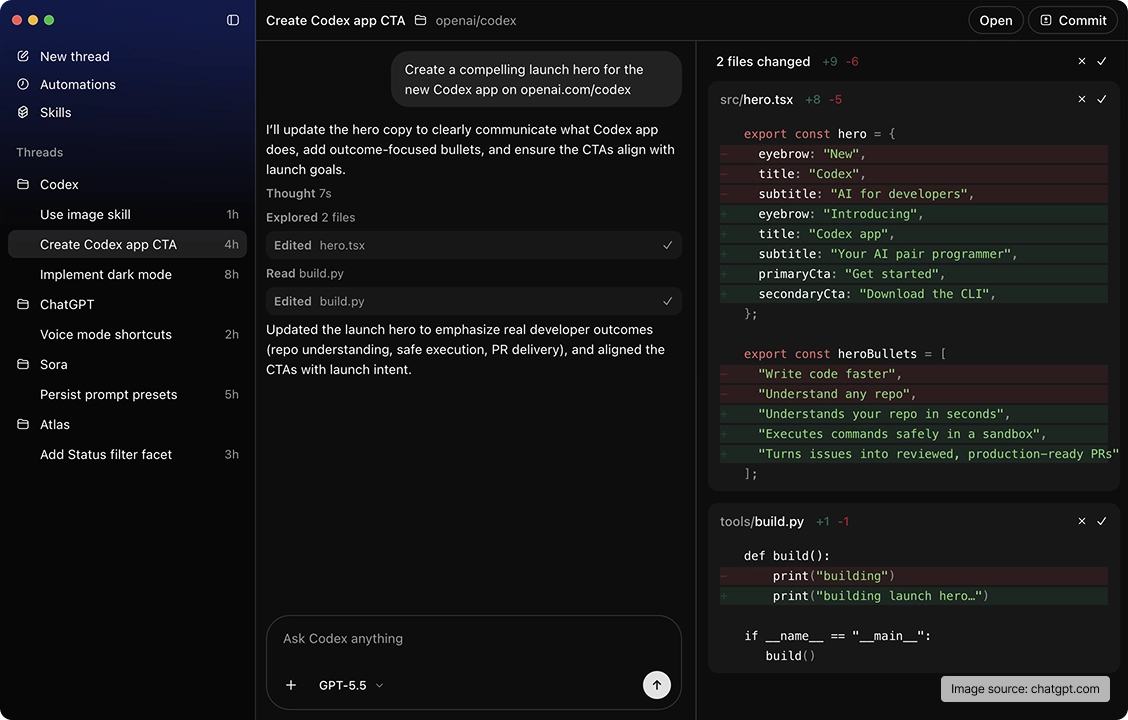
Developers rely on it for:
- Converting PL/SQL to PL/pgSQL
- Rewriting T-SQL logic
- Generating migration scripts
- Creating rollback procedures
- Generating validation queries
- Documenting stored procedures
- Explaining legacy SQL code
- Generating test scenarios
- Suggesting query optimizations
Migration engineers often inherit systems with little documentation and highly customized business logic. Instead of manually reverse-engineering every procedure, developers can use ChatGPT to quickly understand how the code works before starting conversion.
ChatGPT is also useful after automated conversion is completed.
When migration tools encounter unsupported syntax or incompatible database features, developers can use AI to:
- Analyze conversion errors
- Generate alternative SQL implementations
- Rewrite incompatible logic
- Prepare corrected import scripts
- Suggest PostgreSQL-compatible replacements
Another important area is test generation.
Large enterprise migrations may involve thousands of stored procedures, functions, and triggers that need validation after migration. Writing test scenarios manually for every object can require substantial engineering effort.
AI can help generate:
- Regression test queries
- Stored procedure test cases
- Data validation scripts
- Edge-case scenarios
- Integration tests
- Automated QA workflows
At the same time, developers still need to review all generated output carefully. AI-generated SQL may introduce inefficient queries, incorrect assumptions, or logic problems that become critical in production environments.
GitHub Copilot
GitHub Copilot is often used during incremental modernization projects and day-to-day migration development work.
Unlike ChatGPT, which is typically used through prompts and conversations, Copilot operates directly inside the IDE and assists developers while they write code.
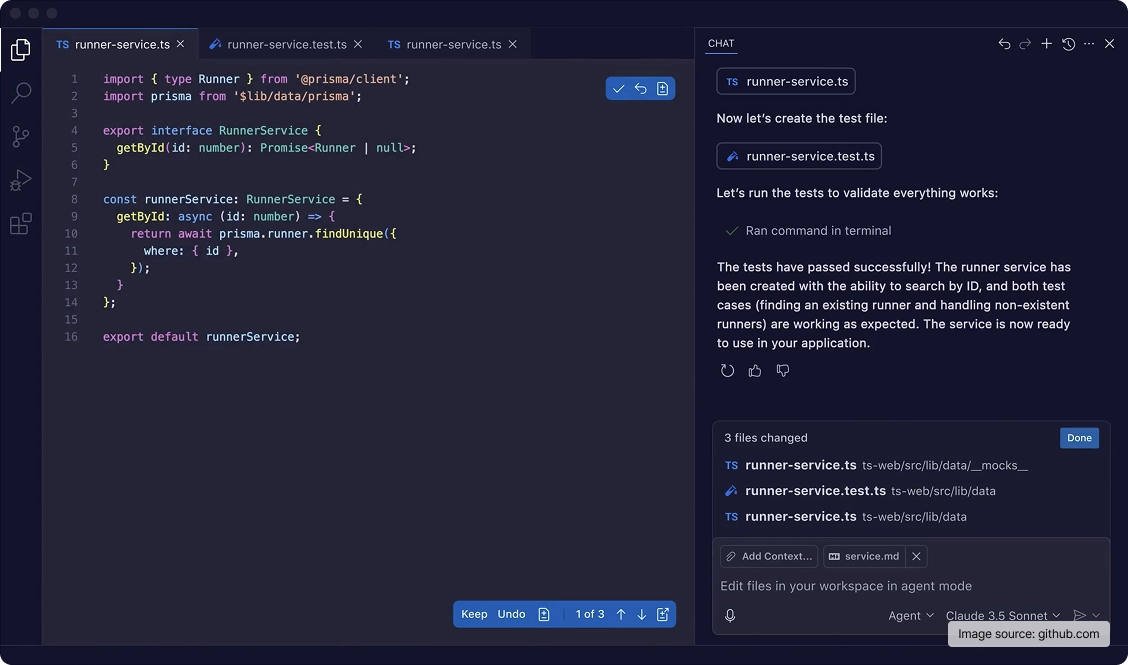
Developers use Copilot for tasks such as:
- SQL generation
- Query refactoring
- ORM migration scripts
- Transformation logic
- Unit tests
- Schema synchronization scripts
- API integration code
- Data mapping routines
Copilot becomes especially valuable when database migration is combined with application modernization.
For example, after migrating from Oracle to PostgreSQL, developers often need to update:
- Application queries
- ORM models
- Transaction handling logic
- Repository layers
- Database connectors
- Service integrations
Many of these tasks are repetitive and time-consuming. Copilot helps accelerate implementation while allowing developers to stay inside their normal workflow.
It works best as a productivity tool rather than a complete migration solution. While it helps engineers write code faster, it does not provide deterministic conversion, dependency analysis, or migration orchestration capabilities.
AWS Schema Conversion Tool (AWS SCT)
AWS Schema Conversion Tool (AWS SCT) focuses on automated schema analysis and heterogeneous database conversion.
Although it is not a generative AI platform, it provides automation capabilities that are useful during migration planning and execution.
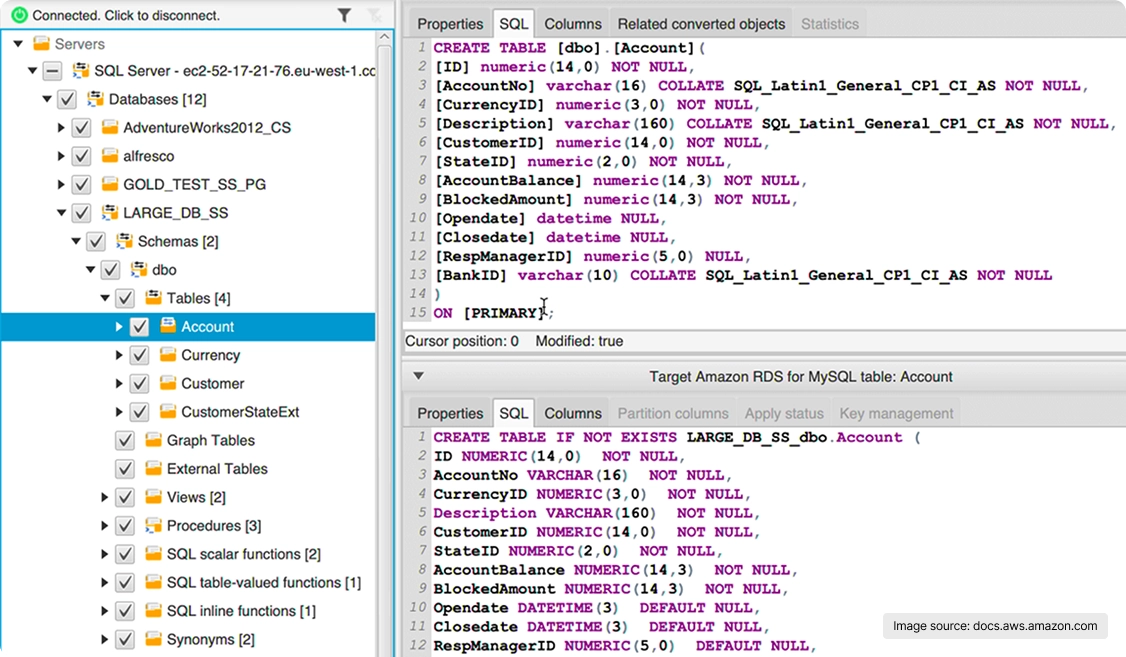
AWS SCT can:
- Analyze source schemas
- Estimate migration complexity
- Convert database objects automatically
- Identify unsupported features
- Generate dependency mappings
- Produce assessment reports
- Suggest conversion strategies
- Identify manual remediation requirements
The platform supports migrations involving:
- Oracle
- Microsoft SQL Server
- Teradata
- MySQL
- PostgreSQL
- Amazon Aurora
- Cloud-native database platforms
One of its strongest capabilities is compatibility assessment.
Before migration begins, engineers can identify which database objects are likely to convert successfully and which components require manual remediation.
For example, AWS SCT can detect:
- Unsupported PL/SQL features
- Incompatible functions
- Vendor-specific SQL syntax
- Unsupported triggers
- Procedural language limitations
- Data type conflicts
This allows developers to estimate project scope and migration risk more accurately before execution starts.
Why AI alone is not enough
AI can generate code quickly, but database migration requires precision and predictability.
Large language models may:
- Misunderstand business logic
- Generate invalid SQL
- Overlook edge cases
- Produce inefficient queries
- Suggest unsafe modifications
In enterprise environments, even a small migration error can affect critical production systems, financial operations, integrations, or reporting workflows.
Another challenge is consistency. AI-generated output may differ between prompts, even when developers request similar conversions. This creates problems for large migration projects where engineers need repeatable and predictable results across thousands of database objects.
Database migration also involves many platform-specific behaviors that AI models may not fully understand, including:
- Transaction handling differences
- Locking behavior
- Trigger execution order
- Package dependencies
- Vendor-specific procedural languages
- Query optimization behavior
- Database engine limitations
For example, code that works correctly in Oracle may behave differently after conversion to PostgreSQL due to differences in transaction management, exception handling, or procedural language features.
AI tools also do not fully understand production infrastructure requirements related to:
- Zero-downtime deployment
- Rollback planning
- Replication
- Failover strategies
- Security restrictions
- Compliance requirements
This is why enterprise migration projects still require experienced engineers, deterministic migration tools, validation procedures, and extensive testing.
AI helps developers work faster, but migration quality still depends on engineering control and verification.
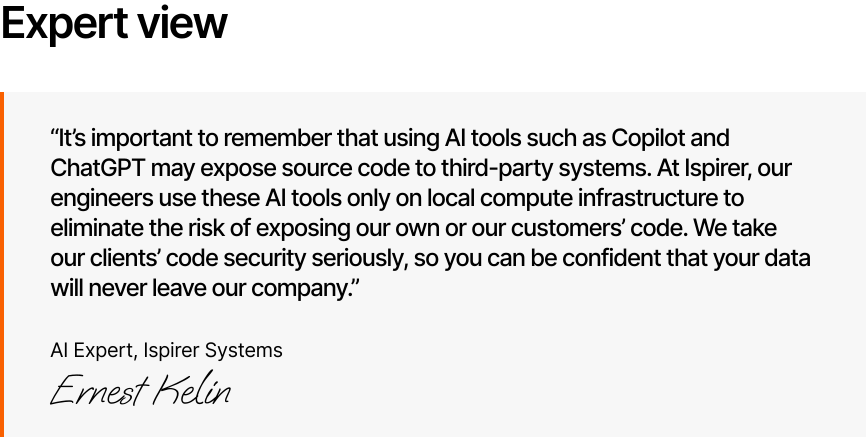
Combining AI with SQLWays by Ispirer
SQLWays by Ispirer is designed for heterogeneous database migration and automated code conversion.
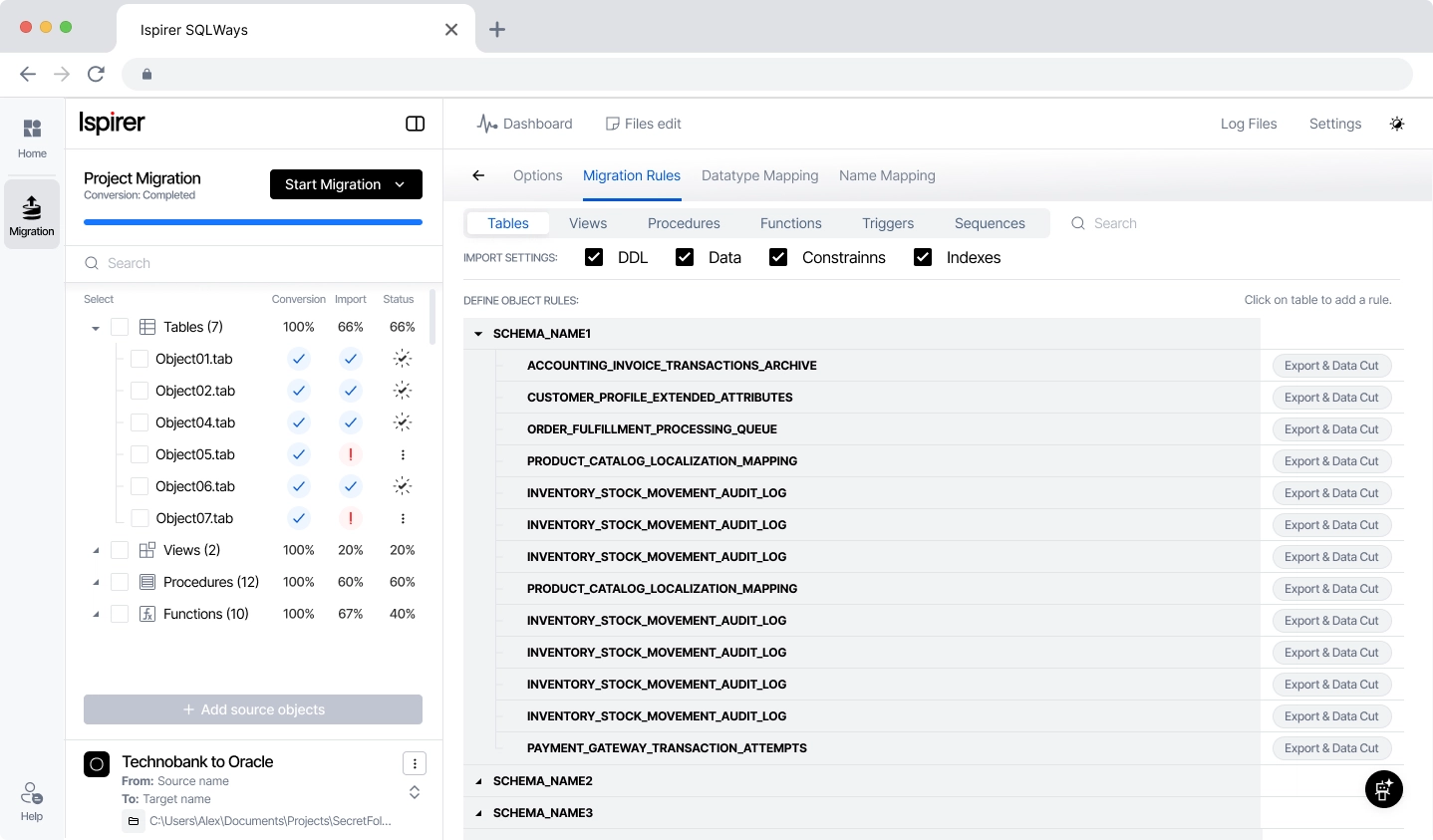
The platform supports migration of:
- Tables
- Views
- Stored procedures
- Triggers
- Functions
- Packages
- User-defined types
- Sequences
- Database schemas
- Data
One of the main differences between SQLWays and AI-based assistants is the conversion approach.
AI tools generate output dynamically based on prompts and context, while SQLWays uses deterministic conversion rules and predefined transformation logic. This allows developers to achieve more predictable and repeatable migration results across large enterprise environments.
In migration projects, engineers often use AI and SQLWays for different tasks.
AI tools help with:
- Legacy system analysis
- SQL explanation
- Migration planning
- Error remediation
- Test generation
- Documentation
SQLWays handles:
- Automated schema conversion
- Procedural code conversion
- Data migration
- SQL dialect transformation
- Dependency-aware conversion
- Controlled migration workflows
This separation is important in enterprise environments where migration consistency and validation are critical.
For example, developers may first use AI tools to analyze undocumented PL/SQL packages and understand business logic. After that, SQLWays performs automated conversion of schemas, procedures, triggers, and other database objects. Engineers can then use AI again to help investigate unsupported syntax, optimize converted queries, or generate additional tests.
This workflow helps reduce manual engineering effort without sacrificing migration control.
Another important advantage is scalability.
Large enterprise databases may contain:
- Thousands of stored procedures
- Complex object dependencies
- Vendor-specific SQL features
- Highly customized business logic
- Multiple interconnected applications
Manually converting such systems is often too slow and expensive. AI can accelerate analysis and remediation, while SQLWays provides structured conversion workflows for large-scale migration execution.
This combination allows organizations to increase migration speed while maintaining predictable conversion behavior and engineering oversight.
The future of AI-assisted database migration
AI will continue changing how database migration projects are executed.
Modern AI tools already help developers analyze legacy systems, rewrite SQL code, generate migration scripts, create test cases, and accelerate remediation after conversion. This reduces large amounts of repetitive manual work and helps engineering teams move faster.
At the same time, enterprise migration projects still require predictability, validation, security controls, and deterministic conversion processes. AI can assist with code analysis, SQL refactoring, documentation, test generation, error remediation, and query optimization, but developers and DBAs still make the critical decisions related to migration architecture, transaction behavior, performance optimization, rollback strategies, zero-downtime deployment, production readiness, and business logic validation.
The most effective migration strategy today is not fully AI-driven migration. Organizations achieve the best results when they combine AI-powered engineering assistance with deterministic migration platforms, controlled conversion workflows, and experienced migration engineers.
This approach allows companies to accelerate modernization projects while maintaining reliability, consistency, and control across enterprise database environments.
Do you have a migration project ahead?
Talk to expert. Save your time


