
Automated Database Migration: 7 Reasons to Move Away from Manual Work
Summary: Database migration often takes more time and effort than expected. In this article, we explain why companies move from manual migration to automation, what problems it helps avoid, and how automated approaches make migrations faster, safer, and easier to control.

Database migration is rarely a simple task. Most developers know the pain: applications can break, hidden bugs appear, and weeks or even months of work can be lost. Different database engines, custom SQL, and legacy code often collide in unpredictable ways, forcing developers to fix issues as deadlines approach.
Manual migration is not just slow; it is risky. Every change must be checked, every dependency tracked, and even a small mistake can create larger problems across the system. Meanwhile, developers could be working on new features, optimizations, or critical bug fixes instead of dealing with repetitive data tasks.
Automation changes this approach. By standardizing the migration process, organizations reduce errors, maintain consistency, and free developers to focus on work that actually delivers value.
In this article, we look at seven reasons why companies move away from manual migration and rely on automation instead.
Database migration automation is more cost-effective
Automating a database migration can save a significant amount of time and effort. Manual migration often takes months, requires experienced specialists, and still carries the risk of errors or delays. Database migration automation reduces repetitive tasks and makes the process more predictable.
Loxon, a financial services company in Hungary, needed to move 13 SQL Server databases and 1 Sybase IQ database to Oracle. Doing it manually would have taken about a year. With Ispirer Toolkit and some custom adjustments, the migration was completed in six months with 92% automation, cutting costs by 3-5 times compared to a manual approach.
The migration included custom handling of SQL Server and Sybase IQ features, from system table columns to complex stored procedures. These tweaks kept the automated process reliable and accurate while reducing the workload for the team.
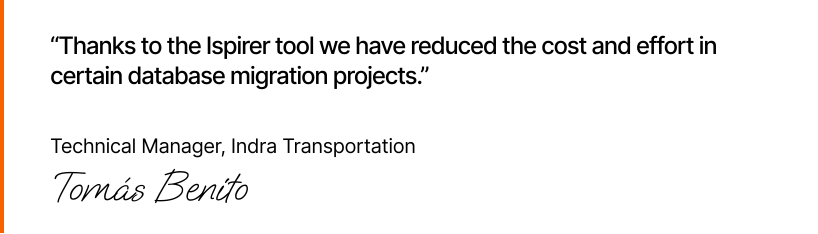
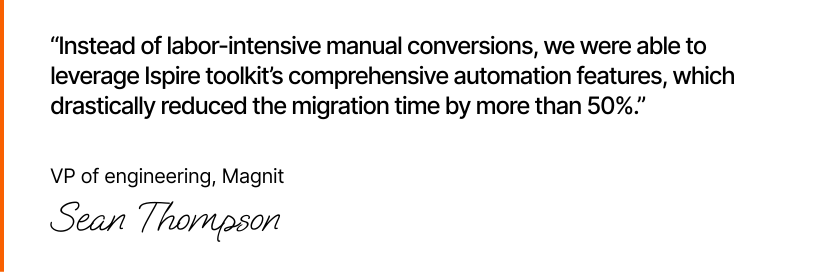
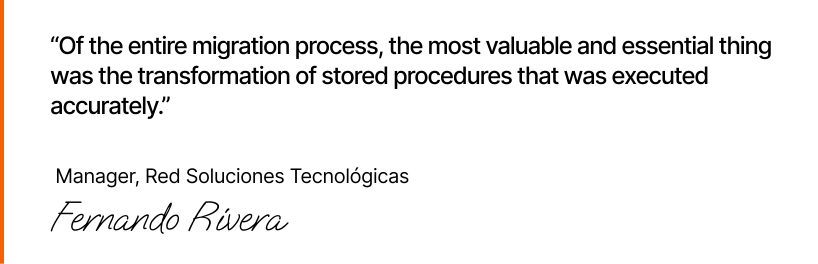
Other clients have noticed similar results:
Automated database migration helps minimize downtime
Downtime can become a serious problem during database migration. In healthcare, even a short interruption can disrupt access to patient records or billing data. Automated database migration helps prevent this by carefully controlling how data is transferred.
A healthcare company in the USA needed to move 8 TB of patient records, medical histories, and billing data from MySQL to Microsoft SQL Server. The goal was to complete the migration quickly and accurately, while keeping all systems running for hospitals and clinics.
Using SQLWays and InsightWays, the migration was split into stages. Schemas were converted automatically, data types were adjusted, and MySQL-specific features were mapped to SQL Server. Large datasets were transferred in parallel batches, supported by data migration workflow automation with incremental updates and validation checks.
Thanks to automation, all data was transferred accurately, compliance with HIPAA was maintained, and the hospital systems stayed fully functional throughout the process. The migration didn’t interrupt daily work, making the transition smooth and reliable.
Accelerate your SQL and data migration
Perfect for small projects
- SQL (LoC) 5,000
- Data (GB) 50
- Duration 1 month
Great for growing teams
- SQL (LoC) 15,000
- Data (GB) 100
- Duration 3 months
Stop wasting time with manual efforts. See how fast our automation can deliver your results
A faster and clearer transition to a new database
Automation focuses on eliminating unnecessary manual work. When SQL code, schemas, and data are converted automatically, migrations stop stalling on minor technical issues. This is where the real benefits of automated database migration become visible.
This matters because migration itself is rarely the goal. The goal is to start working with a new database — with better performance, newer features, and fewer limitations. The faster the move is completed, the sooner teams can leave the old system behind and focus on day-to-day work instead of supporting two environments at once.
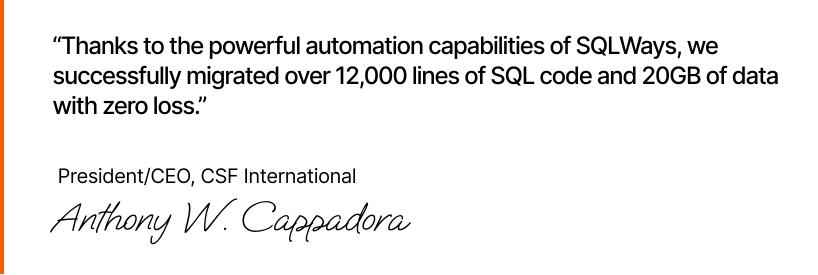
A good illustration of this approach comes from a Ispirer project for a US-based global fintech provider. The company was running both Informix and Oracle and wanted to fully consolidate on Oracle without stretching the migration over a long period of time. Using SQLWays, Ispirer automated most of the SQL conversion and data transfer, migrating 12,000 lines of SQL code and 20 GB of data. Compared to a manual approach, this reduced the overall migration timeline by 60-70% and helped keep downtime to a minimum.
That difference in speed is something Ispirer hears often from other customers as well. When migration doesn’t drag on for months, it stops being a constant background problem. It becomes a finished task — and the team can move on.
Creating room for growth with scalable and future-ready databases
Databases must grow with the business. The ability to automate migration process steps makes it easier to move to platforms that support higher loads and changing requirements.
Automation also supports long-term scalability. Migrating to cloud-native or more flexible systems creates room for expansion and innovation. These are tangible benefits of migrating to a modern database architecture, especially for businesses dealing with seasonal peaks or rapid growth.
A major online fashion retailer faced this challenge when migrating 1.2 million lines of SQL and 8 TB of data from MS SQL Server to PostgreSQL on AWS. Their previous setup made it difficult to support growth during peak shopping periods, such as Black Friday, and limited the company’s ability to respond quickly to evolving customer needs.
Using Ispirer Tools, the migration was completed in five months, much faster than the 12+ months a fully manual process would have taken. Moving to a scalable cloud platform gave the retailer the ability to handle more traffic, grow its user base, and implement new features as the business expanded, creating a foundation for future growth without adding unnecessary complexity.
Database migration automation improves data accuracy
The most important question during migration is simple: did the data arrive correctly? Database migration automation reduces the risk of data loss or corruption by eliminating ad-hoc manual changes.
Automated rules preserve schemas, constraints, and relationships. Automated data validation benefits in data migration are especially important for systems tied to reporting, audits, or regulatory requirements.
This approach was used in an Ispirer project for an IT solution provider in Czechia, migrating from Sybase ASE to PostgreSQL. The project included over 300,000 lines of code and more than 800 tables, with complex business logic. Along with tight deadlines, conversion quality and data correctness were central concerns for the client.
For many teams, this level of control is what defines a successful migration. When the results are predictable and verifiable, there’s no need to rely on assumptions or spot checks — the data in the new system can be trusted.
Ensuring data protection and compliance during database transitions
Data security is critical during any migration. Automated migration keeps transfers controlled, consistent, and verifiable, which reduces the risk of accidental exposure or errors. Compliance and integrity are maintained at every step without relying on repeated manual checks.
Automation also allows processes like query execution, schema conversion, and data transformation to be tracked systematically, making it easier to meet strict security standards.
A major IT services provider in Hong Kong needed to migrate 400,000 lines of code from Oracle to Java. The project had a unique requirement: database queries had to stay at the database level, while other business logic moved to the application. Security rules were strict, reflecting the client’s role in the US financial market.
Ispirer customized its Toolkit for this project, ensuring that queries remained in the database and all other logic was safely migrated. The framework was adjusted to meet the client’s security standards, allowing the migration to proceed smoothly while speeding up the process 2-3 times compared to a fully manual approach.
Getting consistent results instead of surprises
When migrating databases, consistency matters just as much as speed. Automated migration ensures the same rules are applied at every step, making the process predictable and repeatable. It prevents discrepancies that often happen with manual work and adds additional safeguards like data deduplication, compression, and tiering to keep everything under control.
Reliable processes mean fewer surprises. With automation, every conversion follows the same logic, so the results are more predictable. Teams can trust that the migration will produce the expected outcome each time, and any customizations or extensions are applied consistently across the database.
For example, a US-based data and market measurement company needed to migrate 360,000 lines of SQL and 100 GB of data from Sybase ASE to PostgreSQL. The scope included over 1,500 tables, and deadlines were tight. The client needed a solution that would complete the migration efficiently without introducing errors or delays.
Using Ispirer Tools with a six-month license and targeted customizations, the migration was executed on-site with expert support. Crucial extensions and adjustments, like handling user-defined data types and special return behaviors, ensured the process ran smoothly. In the end, all data and code were migrated on time, reducing risks and giving the client a reliable, up-to-date database infrastructure.
Other clients have noticed the same reliability in their migrations — predictable results and smooth execution every time.
SQLWays: automated database migration made easy
SQLWays by Ispirer is a tool designed to make database migrations faster, smarter, and more reliable. As a solution for automated database migration, it handles the conversion of entire database schemas, including tables, stored procedures, functions, triggers, views, and other objects that are usually time-consuming to migrate by hand.
The tool supports a wide range of platforms, including PostgreSQL, Oracle, SQL Server, MySQL, DB2, Sybase ASE, and others. This makes SQLWays a practical option for companies working with heterogeneous environments and planning large-scale transformations using database migration automation tools.
The benefits of using SQLWays include:
- Parallel schema and data migration to save time
- Automated handling of all objects, from views to user-defined types
- Data protection, working with read-only privileges and ensuring no data is sent to third parties
- Customizable migration features to meet the specifics of any source system
- Detailed reporting for fast review and verification of results
In projects, SQLWays is often used as a central Database Migration Tool that helps standardize complex migrations and keep them predictable. Database migration with SQLWays can also be combined with expert-led Database Migration Services when projects require custom logic, strict deadlines, or additional validation.
Together, this approach allows organizations to move away from risky manual work and run migrations that are easier to control, easier to verify, and easier to scale.
When database migration becomes manageable, not stressful
Automating database migrations changes the way you work. Instead of manually tracing dependencies or rewriting SQL by hand, the process runs predictably, letting you trust that the data and code behave as expected.
Once you have a reliable system in place, migrations stop being a gamble. They become something you can schedule, monitor, and complete without last-minute surprises, freeing you to focus on what really matters in your projects.
Table Of Content
- Database migration automation is more cost-effective
- Automated database migration helps minimize downtime
- A faster and clearer transition to a new database
- Creating room for growth with scalable and future-ready databases
- Database migration automation improves data accuracy
- Ensuring data protection and compliance during database transitions
- Getting consistent results instead of surprises
- SQLWays: automated database migration made easy
- When database migration becomes manageable, not stressful
Do you have a migration project ahead?
Talk to expert. Save your time


