
Best Practices for Migrating Legacy Healthcare Applications
Summary: Legacy healthcare system migration requires coordinated database schema conversion, application updates, and integration validation. This article explores the technical and operational factors that help healthcare companies modernize safely.

Modernizing legacy systems in healthcare is rarely a simple infrastructure update. It affects clinical workflows, regulatory exposure, data integrity, and financial operations. For many healthcare companies and engineering teams, defining the best practices for migrating legacy healthcare applications is less about choosing a new platform and more about managing risk, sequencing technical changes, and maintaining operational stability.
Healthcare providers and health tech companies typically decide to migrate legacy healthcare apps under pressure. Database vendors discontinue support, security standards evolve, integration requirements increase, and cloud initiatives reshape infrastructure strategies. At the same time, systems that support patient care cannot tolerate instability. Availability, predictable performance, and data accuracy remain non-negotiable.
Healthcare legacy application modernization therefore requires architectural discipline, technical precision, and coordinated execution across database engineers, developers, DevOps teams, and compliance stakeholders.
Understand the existing architecture before redesigning it
Legacy healthcare environments are rarely simple. A central clinical database may interact with laboratory systems, radiology platforms, pharmacy integrations, billing engines, analytics tools, and external reporting systems. Over years of development, engineering teams add layers of custom logic, reporting queries, and integration rules.
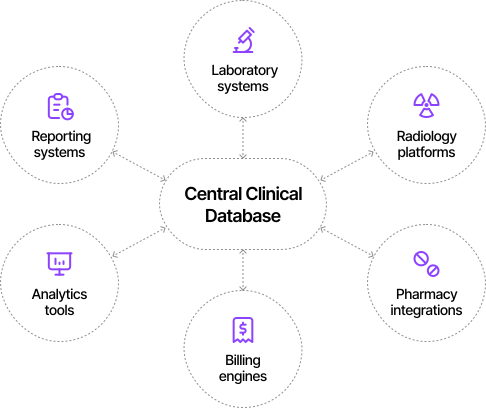
In many systems, stored procedures and database triggers implement core business logic. Reporting modules may rely on specific schema structures. ETL jobs may depend on proprietary SQL functions.
Before defining a target architecture, you should build a clear inventory of:
- Schema object volume and dependency graphs
- Transaction patterns and peak workload behavior
- Indexing strategies and query execution plans
- Integration touchpoints relying on database-specific syntax
Without this baseline, modernization efforts risk breaking hidden dependencies.
In parallel, business and compliance boundaries must be clarified. Acceptable downtime thresholds, recovery objectives, audit logging requirements, and data retention rules influence migration planning from the outset.
Select a migration approach that limits operational disruption
Replacing an entire system in a single cutover may appear efficient, but in healthcare environments it can increase exposure. Interconnected systems often reveal undocumented dependencies only under production load.
A phased migration model generally provides more control. An abstraction or integration layer can isolate legacy components while modules transition incrementally. Administrative features may move first, followed by higher-risk clinical functionality.
This structure enables staged validation and performance benchmarking.
However, phased migration also increases the technical burden. Maintaining alignment between legacy and target environments requires careful handling of database schema, application logic, and integration rules.
Database schema migration as a core technical layer
Database schema conversion is frequently the most technically demanding component of healthcare legacy app modernization. Healthcare databases often contain thousands of objects accumulated over many years:
- Tables with layered constraints and foreign keys
- Views supporting regulatory and financial reporting
- Stored procedures implementing billing logic and eligibility rules
- Triggers enforcing referential consistency
- Sequences and identity mechanisms
- User-defined types and global variables
When moving between platforms such as Oracle, SQL Server, PostgreSQL, Informix, DB2, or cloud-managed services, differences extend beyond syntax. Developers must address variations in:
- Data type precision and scale
- Transaction isolation defaults
- Indexing and partitioning mechanisms
- Reserved keywords
- Package and procedural language behavior
- Identity and sequence handling
Manual schema conversion at this scale increases the likelihood of inconsistencies.
SQLWays by Ispirer focuses specifically on heterogeneous database schema conversion. The tool automates structural transformation while preserving object relationships and dependency order. It supports conversion of tables, views, procedures, functions, triggers, sequences, packages, and user-defined types, along with configurable data type mapping and conflict resolution.
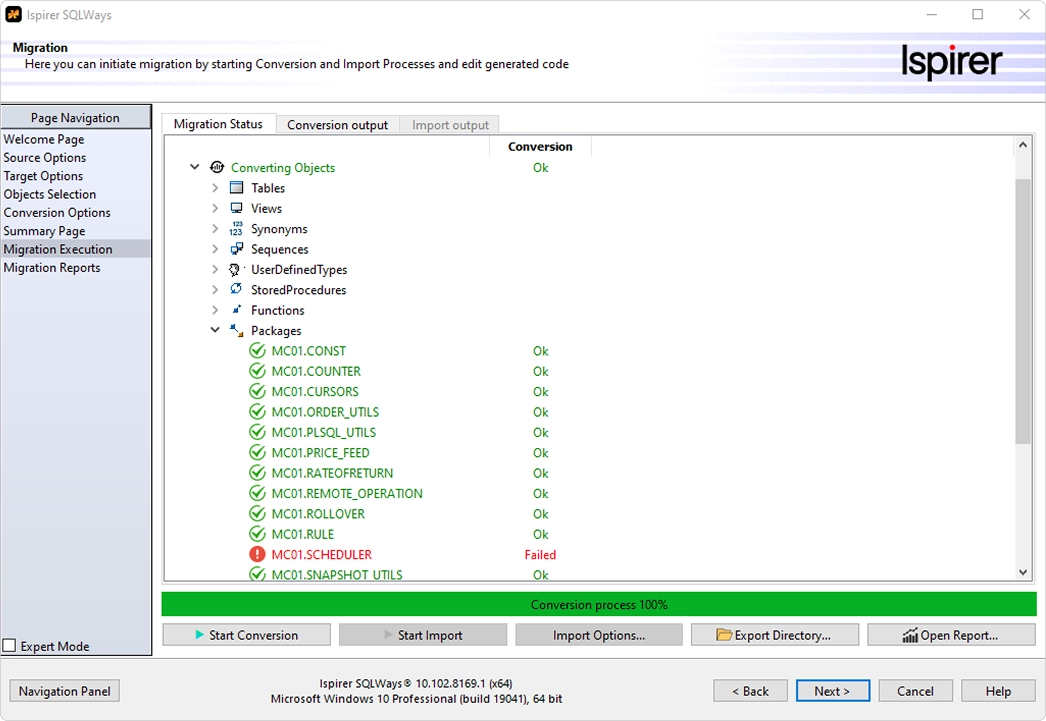
SQLWays operates with read-only access to the source database and does not modify original structures — an important factor for healthcare companies operating under strict audit controls. Detailed conversion reports allow engineering teams to review results systematically.
Automating schema conversion does not eliminate testing requirements, but it reduces repetitive manual work and supports structural consistency.
Want to see SQLWays in action?
Separate structural conversion from data validation
Schema alignment ensures compatibility at the structural level, but healthcare legacy app modernization also requires rigorous data validation.
Healthcare databases often contain decades of longitudinal patient data and billing history. Common challenges include duplicate identifiers, inconsistent coding standards, outdated formats, and legacy reference tables.
Data validation should extend beyond simple record counts. Effective validation typically includes:
- Referential integrity verification
- Reconciliation of critical clinical tables
- Validation of financial calculations
- Performance benchmarking on realistic data volumes
Testing high-risk workflows — such as medication retrieval, allergy checks, and claim generation — ensures that business logic continues to function correctly after migration.
Align application logic with database changes
Database logic in healthcare systems is frequently embedded within application code. Legacy app modernization healthcare companies undertake often involves applications built in Delphi, COBOL, Informix 4GL, or Progress 4GL, with embedded SQL tightly coupled to database behavior.
When schema definitions change, embedded SQL statements must be updated to reflect new syntax and data handling rules.
CodeWays by Ispirer supports automated cross-platform application conversion and adapts embedded SQL to align with target database platforms. Automating code transformation reduces manual rewriting effort and helps maintain consistency between database and application layers.
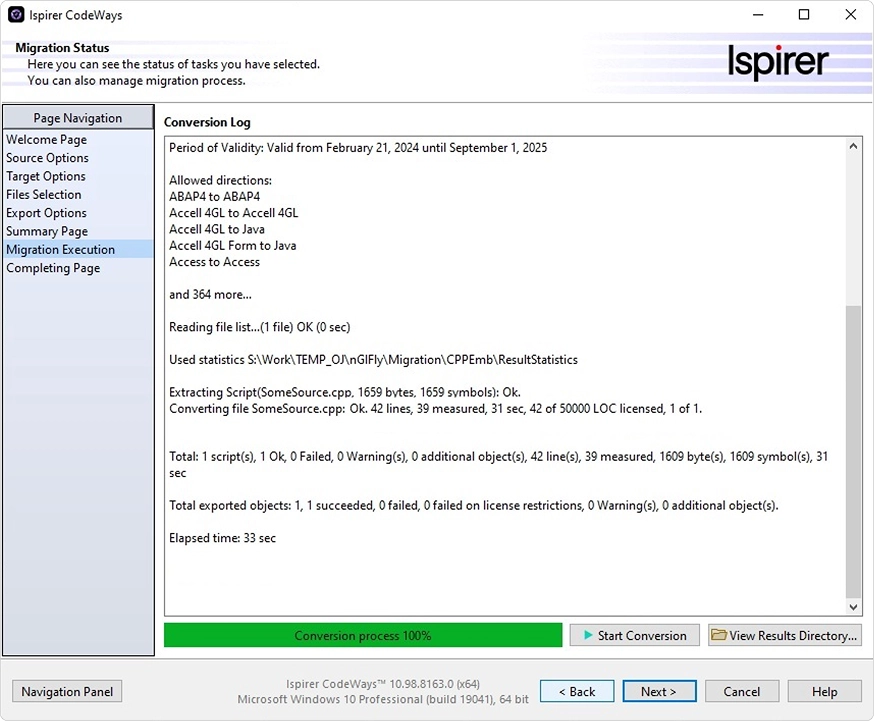
Coordinated updates across schema and application components simplify integration testing and reduce post-migration corrections.
Consider cloud and hybrid deployment implications
Many healthcare providers are moving from on-premises infrastructure to cloud or hybrid environments. This shift introduces architectural considerations beyond schema conversion.
Developers must account for network latency, managed service limitations, scaling behavior, backup models, and security group configuration. Some database features available on-premises may require redesign in managed cloud services.
Performance testing in staging environments is essential before production rollout. Query plans and indexing strategies may behave differently in cloud-managed engines.
Evaluate integration impact early
Healthcare systems depend heavily on integration stability. Schema changes can affect:
- HL7 message processing
- ETL pipelines
- API responses
- Analytics dashboards
- External reporting submissions
Engineering teams should maintain a documented inventory of integration dependencies and validate full end-to-end workflows during testing.
Testing isolated database queries is insufficient. Real operational scenarios must be simulated to confirm stability.
Governance, audit, and compliance controls
Migration processes must preserve regulatory alignment. Healthcare companies operate under strict data protection and audit requirements.
Maintaining read-only access to the source system during schema conversion, segregating development and production environments, and documenting every structural change are essential practices.
Automated reporting from schema conversion tools supports internal review and compliance documentation. Controlled, repeatable processes are preferable to ad-hoc scripting.
Post-migration stabilization and optimization
Deployment is not the final stage. After go-live, engineering teams typically monitor query performance, adjust indexing strategies, and analyze execution plans. Differences between database engines can affect optimizer behavior even when schema definitions are aligned.
Monitoring production workloads and reviewing error logs ensures that performance remains consistent with baseline expectations.
Healthcare legacy application modernization is defined less by speed and more by control. Structured assessment, phased execution, disciplined schema conversion, coordinated application updates, and comprehensive validation form the foundation of a stable migration process.
When engineering teams combine careful planning with automated schema conversion and aligned application updates, healthcare companies can modernize legacy environments while maintaining operational reliability, regulatory compliance, and data integrity.
Deepen your knowledge with these reads
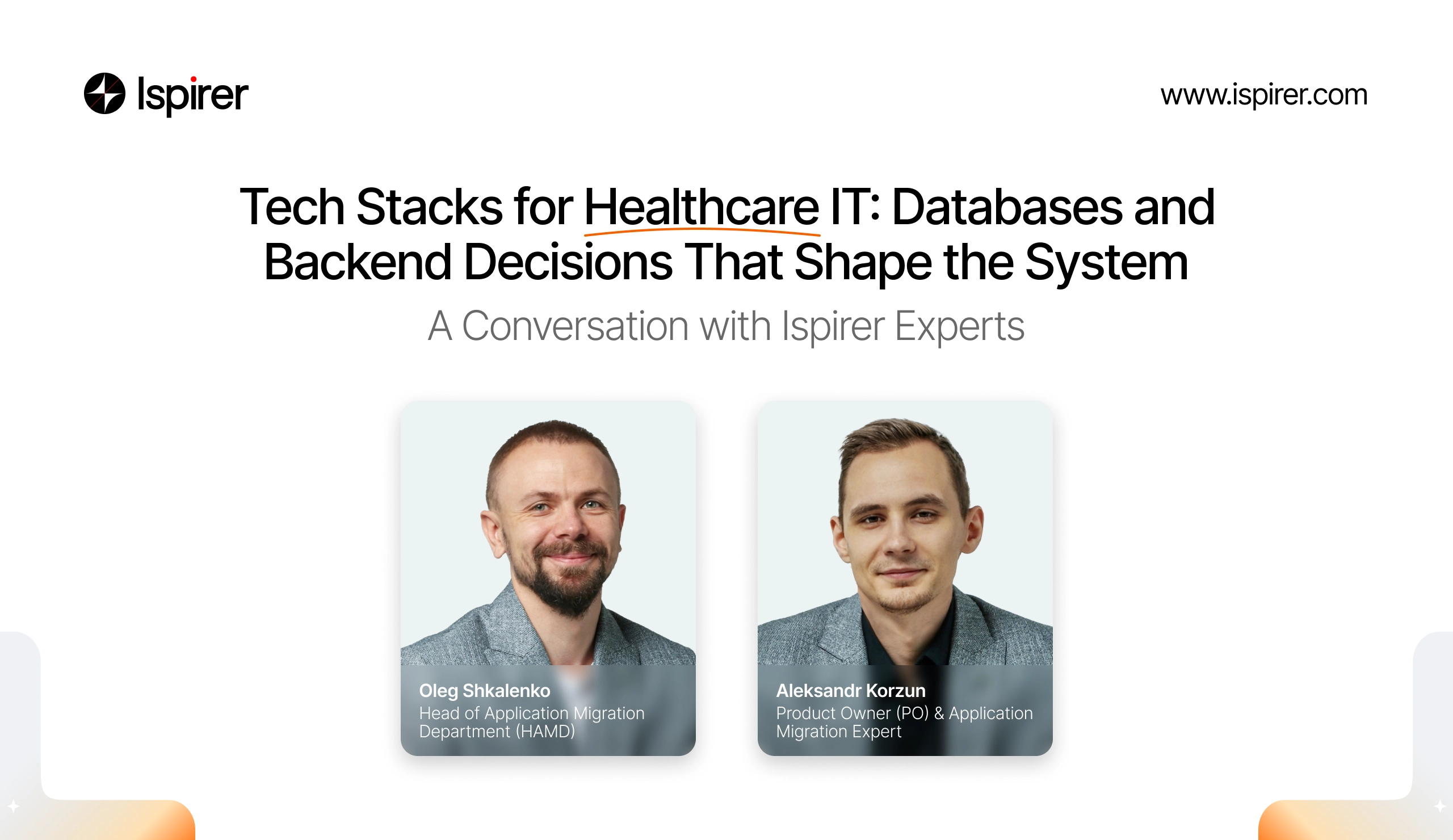
Tech Stacks for Healthcare IT: Databases and Backend Decisions that Shape the System
April 17, 2026
Tech stack decisions in healthcare are harder to change later. Here’s what to consider when choosing databases and backend architecture.
What is the Best Cloud for Healthcare?
March 24, 2026
An overview of major cloud platforms used in healthcare and the factors organizations consider when selecting infrastructure for medical systems and applications.
What is Data Migration in Healthcare? A Complete Guide
February 28, 2026
Healthcare data migration is a complex process that directly affects compliance, clinical accuracy, system stability, and continuity of care during IT transitions.
Database Cloud Migration in Healthcare Without Breaking Clinical Systems
February 03, 2026
We discuss why Healthcare databases are harder to move and how to migrate them without disrupting clinical workflows.
Data Migration Tools for Healthcare Data and the Challenges They Help Address
January 20, 2026
An overview of data migration tools for healthcare data, key differences between them, what to consider when choosing a tool, and how to prepare data and processes for migration.
How Ispirer Customization Powers High-Speed Application Migration
August 25, 2025
Migrating your application? Learn how customization helps achieve higher levels of automation for your migration project.
7 Signs It’s Time to Modernize Your Application

May 08, 2025
Not sure why you need modernization? Check out the main signs that indicate it's time to modernize
Delphi Modernization and Migration with Codeways Toolkit

April 17, 2025
Accelerate Delphi to .NET modernization with CodeWays. Assess codebase quality, ensure cross-platform compatibility, and migrate legacy applications efficiently
Table Of Content
- Understand the existing architecture before redesigning it
- Select a migration approach that limits operational disruption
- Database schema migration as a core technical layer
- Separate structural conversion from data validation
- Align application logic with database changes
- Consider cloud and hybrid deployment implications
- Evaluate integration impact early
- Governance, audit, and compliance controls
- Post-migration stabilization and optimization
Do you have a migration project ahead?
Talk to expert. Save your time


