
What is the Best Cloud for Healthcare?
Summary: This article looks at the major cloud platforms used in healthcare, explains what organizations usually consider when choosing a platform, and shows when a hybrid approach that combines local infrastructure with cloud services can be useful.

Healthcare organizations rely more and more on digital systems to manage patient records, coordinate care, and support research. As healthcare data keeps growing, many organizations start using cloud for healthcare environments to store and process this information.
Cloud platforms provide scalable infrastructure, computing resources, and tools that help healthcare teams manage complex systems and large datasets. At the same time, moving healthcare workloads to the cloud requires careful planning.
Medical data is sensitive, healthcare systems run continuously, and regulations define how information can be stored and accessed. Because of this, choosing a cloud platform is not just a technical decision. It also affects security, compliance, and the stability of healthcare services.
In this article, we look at why cloud platform selection matters in healthcare, review several commonly used platforms, and discuss what organizations usually consider when choosing a cloud solution for healthcare environments.
Why сhoosing the right cloud platform matters
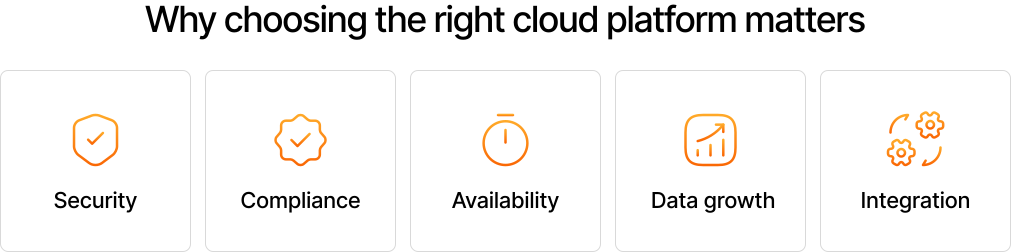
Healthcare systems work with some of the most sensitive types of information. Medical records contain personal data, diagnoses, treatment history, and clinical notes. Protecting this information is essential for both patient trust and legal compliance.
Healthcare organizations also operate under strict regulations. Laws such as HIPAA in the United States and GDPR in Europe define how healthcare data can be stored, processed, and shared. This makes cloud security for healthcare one of the most important aspects when adopting cloud technologies.
Another important aspect is system availability. Doctors and medical staff rely on digital systems during patient care. Electronic health records, laboratory systems, and imaging platforms must remain accessible at all times. Even short outages can interrupt clinical workflows.
Healthcare also produces large amounts of data. Imaging systems, monitoring devices, lab results, and clinical documentation generate new data every day. Many organizations rely on cloud storage for healthcare and scalable cloud storage for medical records to handle this growing volume of information.
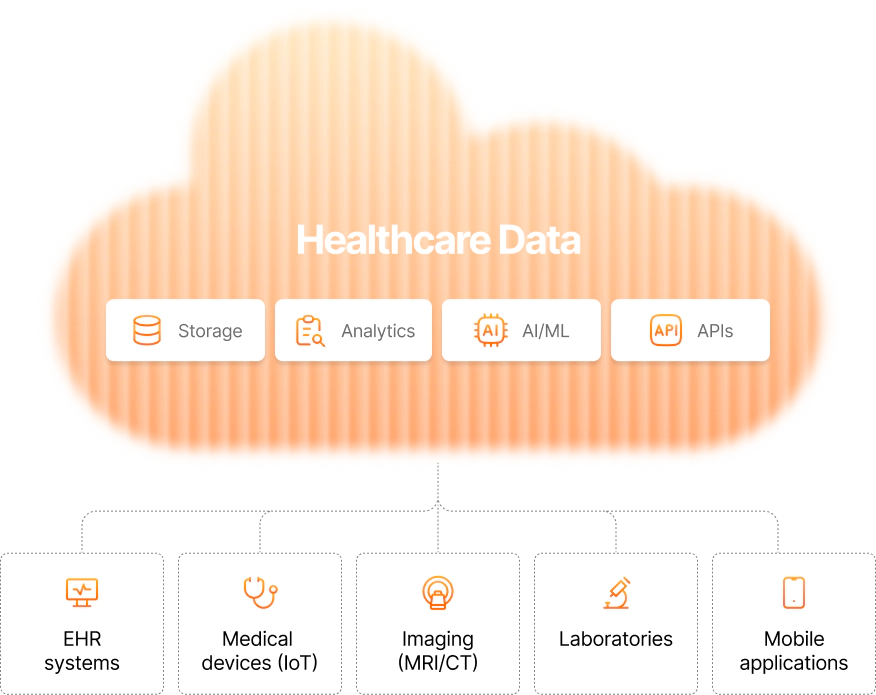
Integration between systems is also critical. Hospitals operate many applications that exchange data with each other. These systems often rely on healthcare standards such as FHIR, HL7, and DICOM. Platforms that support these standards make it easier to connect systems and share information.
Healthcare organizations are also increasingly using analytics and machine learning. Modern infrastructures often function as a data cloud for healthcare, where large datasets can be processed and analyzed to support research and clinical insights.
Major cloud solutions for healthcare industry
Amazon Web Services (AWS)
Amazon Web Services is one of the most widely used platforms when organizations look for the best cloud for healthcare. Hospitals, research organizations, and healthtech companies often choose AWS because of its large ecosystem of services and strong infrastructure.
AWS provides several services that are particularly useful for healthcare workloads.
Examples include:
- Amazon HealthLake – organizes clinical data in standardized formats
- Amazon Comprehend Medical – extracts medical concepts from clinical text
- AWS IoT services – integrate data from medical devices
- AWS analytics services – process large healthcare datasets
Many healthcare organizations also use AWS for projects such as:
- Medical imaging analysis
- Healthcare analytics
- Machine learning models
- Research data processing
AWS environments often support modern cloud-based healthcare platforms and applications such as cloud based ehr for medical practices that allow clinics to manage electronic health records without maintaining complex infrastructure.
Microsoft Azure
Microsoft Azure is another major healthcare cloud platform widely used in healthcare environments. Many hospitals adopt Azure because it integrates well with existing enterprise IT systems.
Azure provides solutions designed specifically for healthcare data management.
Key services include:
- Azure Health Data Services – supports healthcare data standards such as FHIR
- HL7 integration tools – enable communication between clinical systems
- API services – support healthcare application integration
Azure is frequently used as part of cloud engineering for healthcare platforms, where infrastructure is designed to support large-scale healthcare applications and data exchange.
Azure also connects easily with other Microsoft tools that healthcare organizations already use.
For example:
- Microsoft Teams can support communication between healthcare staff
- Power BI can analyze clinical and operational data
- Microsoft 365 tools support collaboration across healthcare teams
Many providers also build internal systems such as a cloud-based healthcare management platform that helps manage patient data, scheduling, and operational workflows.
Google Cloud Platform (GCP)
Google Cloud Platform is particularly strong in data analytics and machine learning. These capabilities make it attractive for healthcare research and data-driven healthcare applications.
GCP provides services designed to support healthcare data processing.
Important services include:
- Google Cloud Healthcare API – supports healthcare data standards
- BigQuery – analyzes large healthcare datasets
- Vertex AI – develops machine learning models for healthcare applications
The Healthcare API supports several key healthcare standards:
- FHIR for clinical data exchange
- HL7 for healthcare messaging
- DICOM for medical imaging
DICOM support is especially important for healthcare organizations that manage large collections of imaging data such as MRI or CT scans.
Healthcare research organizations often use Google Cloud for analytics projects and large-scale data processing.
ClearDATA
ClearDATA is a platform designed specifically for healthcare organizations. Instead of providing its own infrastructure, it builds services on top of major cloud providers such as AWS, Azure, and Google Cloud.
The main focus of ClearDATA is security and regulatory compliance. Healthcare organizations often face complex compliance requirements, and ClearDATA provides tools that help manage them.
Key capabilities include:
- Automated compliance monitoring
- Continuous security monitoring
- Threat detection and response
- Compliance reporting
This allows healthcare technology companies to run their systems in the cloud while maintaining regulatory compliance.
ClearDATA is often used by digital health companies and healthcare software providers that need strong compliance support.
Atlantic.Net
Atlantic.Net provides cloud infrastructure designed for healthcare environments that must meet HIPAA requirements.
The platform offers preconfigured environments for healthcare applications. These environments make it easier to deploy compliant systems without building security controls from scratch.
Key features include:
- HIPAA-ready infrastructure
- Managed security services
- Backup and disaster recovery options
Atlantic.Net is often used by organizations looking for a reliable cloud solution for healthcare that includes built-in compliance capabilities.
Planning a move to the cloud?
We can help with your migration
How to choose a cloud platform for healthcare
Selecting a cloud platform for healthcare involves evaluating several technical and operational factors. Organizations typically look for a platform that protects patient data, integrates with existing systems, and supports long-term digital development.
1. Regulatory compliance
Healthcare organizations operate under strict regulatory frameworks. These regulations define how patient data can be stored, accessed, and transferred.
When evaluating a provider, organizations review whether the platform supports regulatory standards such as HIPAA or GDPR. Providers usually publish compliance documentation and tools that help healthcare organizations maintain regulatory alignment.
2. Security capabilities
Security is one of the main concerns when healthcare organizations move workloads to the cloud. Encryption, identity management, and monitoring tools protect sensitive data and help organizations maintain secure environments.
These security mechanisms are essential for protecting medical information and answering common concerns such as how safe is cloud storage for healthcare.
3. Support for healthcare data standards
Healthcare systems rely on standards such as FHIR, HL7, and DICOM to exchange information between systems.
Platforms that support these standards simplify system integration and improve interoperability across healthcare infrastructure.
4. Reliability and availability
Healthcare systems must operate continuously. Doctors and clinical teams rely on digital systems during patient care.
Cloud providers typically design infrastructure with redundancy and distributed architecture to reduce downtime.
5. Scalability
Healthcare organizations continuously generate new data through imaging systems, clinical documentation, and monitoring devices.
Cloud platforms allow organizations to increase storage and computing resources when necessary without rebuilding infrastructure.
6. Integration with existing systems
Most healthcare organizations already operate complex IT environments that include electronic health records, laboratory systems, imaging platforms, and administrative tools.
Cloud platforms should integrate with these systems through APIs and healthcare data standards.
7. Operational complexity and cost
Organizations also consider how easy the platform is to manage and how costs will evolve over time.
Cloud infrastructure can support many operational systems in healthcare, including financial and administrative services. For example, modern systems may include advantages of cloud-based healthcare payment platforms that integrate billing, insurance processing, and patient payments.
Combining on-premise infrastructure with cloud
Many healthcare organizations combine local infrastructure with cloud services. This hybrid model allows organizations to adopt cloud technologies gradually while maintaining control over critical systems.
Sensitive patient data may remain on local infrastructure where organizations manage security policies directly. At the same time, cloud environments support analytics, application hosting, and large-scale data processing.
Hybrid architectures are also common during cloud migration for healthcare, where organizations move systems step by step rather than migrating everything at once.
Cloud platforms can also support workloads such as:
- Medical imaging analysis
- Large research studies
- Machine learning workloads
Cloud technologies also enable operational systems used by clinics and healthcare providers, including administrative platforms and cloud computing for medical offices.
Cloud storage is frequently used for backup and disaster recovery. Systems and clinical data can be restored quickly if local infrastructure experiences a failure.
Cloud database migration with SQLWays
When you migrate a database to the cloud, one of the main challenges is adapting the existing system to a new database engine without breaking functionality or rewriting everything manually. SQLWays, developed by Ispirer, is designed to handle this task through automation and a structured migration approach.
SQLWays focuses on database conversion. It analyzes the source database, converts schema objects and SQL code, and prepares them for the target cloud platform. This allows teams to significantly reduce manual work and speed up migration timelines.
Key capabilities of SQLWays include:
- Automated database conversion
SQLWays converts database schema, SQL queries, and procedural code using a large set of predefined rules and automated validation.
- Support for cloud platforms
The solution supports migration to platforms such as Amazon Aurora, Amazon Redshift, Azure SQL, Azure Synapse, Google Cloud SQL, and Oracle Cloud.
- Handling of database-specific features
Differences in SQL dialects, data types, and procedural logic are addressed during conversion to ensure compatibility with the target system.
- Configurable migration process
The tool provides flexible settings for handling database objects and supports multithreaded data migration for large volumes.
- Integration into a full migration workflow
SQLWays is used as part of a broader process that includes planning, testing, validation, and production rollout.
- Support for complex and legacy systems
The solution is suitable for heterogeneous environments and databases with extensive custom logic.
- Built-in testing and validation
Converted code and migrated data can be verified through multiple testing stages, including data integrity and performance checks.
In addition to the tool itself, Ispirer provides engineering support if needed — from migration planning to execution and optimization. This combination of automation and expertise helps teams move databases to the cloud in a more predictable and controlled way, especially in environments with strict requirements such as healthcare.
Want to try SQLWays?
Final thoughts
Healthcare organizations rarely move everything to the cloud at once. Most begin with specific workloads such as analytics, research projects, or storage and gradually expand their cloud environments.
Over time, cloud infrastructure often becomes the foundation for digital healthcare systems. Platforms evolve into environments that support patient data management, analytics, and clinical applications.
The most effective architectures usually combine cloud resources with existing infrastructure. This approach allows organizations to modernize systems gradually while maintaining the security and reliability required in healthcare environments.
Do you have a migration project ahead?
Talk to expert. Save your time


